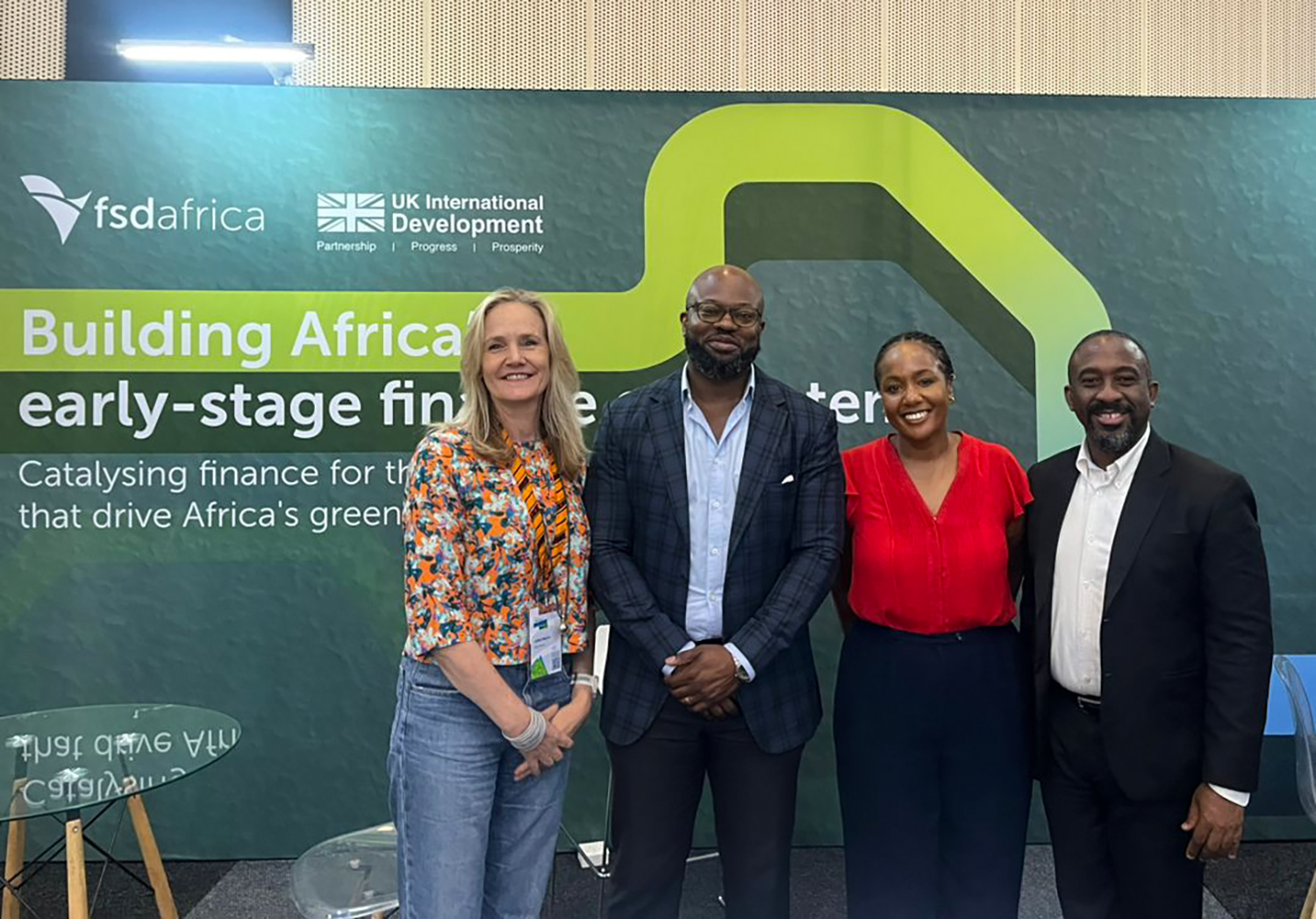
L – R: Alex Ramnyika from the Uganda National Social Security Fund, Evah Kimani from Britam Micro Insurance, Abishkar Shrestha from Visa Foundation, Kento Tanaka from JICA, Nathalie Yannic from Proparco, and Juliet Munro from FSD Africa. Photo FSD Africa/Mireille Ferrari.
At the 22nd conference of AVCA, held in Nairobi on 27 April 2026, one of the opening plenaries – convened by FSD Africa and moderated by its Director of Early Stage Finance, Juliet Munro – focused on a question that continues to shape conversations around African venture capital: why does global capital still dominate, and what would need to shift for domestic investors to play a much bigger role?
Bringing together experts and practitioners from development finance institutions (DFIs), corporates, foundations, and pension funds, the discussion stayed close to the practical realities on the investor side. These are the limited partners (LPs), the institutions that allocate capital into venture funds. What emerged wasn’t a lack of interest from local investors, but a set of frictions around how institutions are set up, how risk is defined, and how venture capital fits (or doesn’t) within existing mandates.
Running through the discussion was a broader concern: if the early-stage capital base continues to weaken, the future pipeline of larger investments across the continent could weaken with it.
How DFIs are shaping the market
There was general consensus across the panel that the market is evolving, albeit unevenly. Venture capital in Africa is becoming more deliberate, less driven by hype, but many of the underlying structures haven’t kept pace.
Natalie Yannic from Proparco reflected on the role DFIs have played so far. A long-standing investor in African venture capital, Proparco has committed more than EUR 4.6 billion across the continent between 2022 and 2025. She noted that “the role of DFI is to show what is possible by committing capital, and to attract private capital” with the longer-term objective being “to eventually give the baton to private investors.” The handover is still in progress, however, highlighting the need for more exits in the ecosystem.
Kento Tanaka, Kenya representative for the Japan International Cooperation Agency (JICA), emphasised that “Africa investments should focus not on short term cycled dynamics, but clear strategic intents.” For JICA, that means working closely with governments to build the policy and market conditions that allow startups to grow and become investable. This includes platforms such as NINJA (Next Innovation with Japan), which connect startups to capital while strengthening the broader ecosystem. In that sense, the role of DFIs goes beyond deploying capital. They help create the conditions that make it possible to crowd in more domestic and institutional capital over time.
For Visa Foundation, the challenge lies in how venture capital is structured. As Senior Director of Investments Abishkar Shrestha put it, “once you commit, you delegate.” Referring to the way investors commit capital to a fund but leave investment decisions to the fund manager, a structure that can be difficult for institutions used to more direct oversight.
This reflects a deeper mismatch. Pension and insurance systems were built around predictable, liquid assets, while venture capital is long-term and illiquid by design. Many local institutional investors don’t yet have the mandates, structures, or risk frameworks to invest in venture capital funds. In addition, Local LPs face market, regulatory, and policy constraints that further limit their participation.
At the same time, this creates a different kind of opportunity. Rather than retrofitting existing systems, there is space to build the ecosystem and the capital structures together, so that local investors can participate more gradually and on terms that fit.
Why local investors aren’t (yet) set up for venture capital
From Britam Holdings, Chief Executive Officer of Britam Microinsurance Evah Kimani brought the discussion back to what participation looks like in practice. Corporates are already engaging with startups – not just as investors, but as value-adding partners providing capital, business support, distribution channels, customers, and platforms for scale.
The primary constraint is regulatory, she noted: insurance firms are limited in how much risk they can take on, even where there is clear strategic value. Without more flexibility, and ways to share that risk, their participation in venture will remain limited. She also emphasized the need for greater collaboration among investors and for regulators to enable more innovation to support ecosystem growth.
From Uganda National Social Security Fund(NSSF), Head of Strategy Alex Rumanyika offered a more direct framing of why this matters internally, noting that “if we don’t enter into this space, it is an existential crisis for pension funds.” A big part of the work starts internally, bringing investment, risk, and leadership teams along to get comfortable with a space that sits outside traditional mandates.
They are testing what participation could look like in practice – starting with grant-like or CSR structures, backing hundreds of startups, and now moving toward a more formal investment approach through a fund of funds. The logic is straightforward: if pension funds are to grow, the economies they depend on need to generate more businesses and more jobs. That, in turn, creates more contributors into the system. Supporting SMEs and new sectors is not just about diversification – it is about helping to build the future member base.
What to watch over the next year
Juliet Munro closed the session by asking each panellist to name one priority that, if progress is made over the next 12 months, could start to shift the balance of capital. The answers were specific, and together they offer a useful way to track what changes between now and the next AVCA conference in 2027:
- Progress on exits and liquidity, to give investors clearer line of sight on returns
- Stronger relationships and clearer communication between fund managers and investors, particularly as newer LPs enter the space
- Early signs of domestic institutional capital coming in at scale, not just at the margins
- Regulatory space for corporates to participate more actively
- The emergence of local investment vehicles, especially funds of funds in local currency, that pension funds can realistically allocate to
What changes between now and the next AVCA will give a clearer sense of how quickly that shift is actually happening.