Category: Press release

African financial institutions pledge to protect and restore nature in landmark statement

“Nature Voices Pledge” will be launched at a Presidential Panel on nature at the Africa Climate Summit

Nairobi, September 5th, 2023: Some of Africa’s largest financial institutions are backing a call to conserve and restore nature amid a biodiversity crisis that threatens the wellbeing and livelihoods of tens of millions of its people.

The landmark “Nature Voices Pledge” is being launched by the African Natural Capital Alliance (ANCA), a collaborative membership organisation whose collective assets total US$390 billion. Among its members are major financial institutions such as Standard Chartered, KCB, Equity Bank, Ecobank, Access Bank, DBSA, Zanaco, FirstRand, Investec, Sanlam, Old Mutual, CalBank, ICEA LION and Fidelity Shield.

The Pledge commits the ANCA membership, which also includes governmental organisations such as the Ghana Ministry of Environment, Science, Technology and Innovation (MESTI) and civil society organisations including the African Wildlife Foundation, to support conservation and restoration efforts, integrate nature into their decision-making and promote sustainable financing solutions.

It comes amid growing evidence that the natural capital on which tens of millions of Africans depend is being lost due to factors including overexploitation, overpopulation, land-use changes and climate change. The value of the natural capital lost to Africa every year is estimated to be $195 billion according to the United Nations Environment Programme (UNEP).

The “Nature Voices Pledge” is to be announced at a Presidential Panel titled “Pioneering the Future of Nature in Africa” which is being hosted by the Africa Climate Summit 2023 on 5th September 2023

The event, which is being supported by ANCA, brings together leaders from several African nations including the Presidents of Rwanda, Republic of Congo and Burundi, to engage in a high-level dialogue on the future of nature in Africa. It will provide a platform for African leaders to discuss key challenges, opportunities, and policy interventions aimed at promoting nature and biodiversity for sustainable development across the continent.

The ‘Nature Voices Pledge’ encapsulates the shared commitment of ANCA’s member institutions to prioritise nature-positive practices and integrate environmental considerations into their core operations. It highlights three key principles that underline ANCA’s dedication to shaping a more sustainable and resilient Africa:

  • Acknowledging the Importance of Nature
  • Emphasizing the African Context
  • Assuming Responsibility

The Pledge also sets out a set of concrete actions ANCA members will take to achieve their nature-centred goals:

  • Support Nature Conservation and Restoration
  • Integrate Nature into Decision-Making
  • Promote Sustainable Financing Solutions
  • Strengthen Transparency and Reporting
  • Support Alignment of Policies and Regulations
  • Foster Collaboration and Knowledge Sharing

This historic commitment underscores the group’s urgency and conviction in driving transformative change toward a sustainable future for Africa.

Dorothy Maseke, Head of ANCA Secretariat and Lead of Nature Finance at FSD Africa, said:

“We in Africa are privileged to live on a continent so rich in natural capital but we must also recognise that our economy and our well-being depends on using it sustainably. This landmark pledge signifies that the members of ANCA are determined to play our part by putting nature at the heart of decision-making, so we reflect its true value and drive investment into activities which conserve and enhance nature rather than destructive activities for short term gain.”

Kaddu Sebunya, CEO, African Wildlife Foundation, said:

“As we stand on the cusp of the Africa Climate Summit, we come with a resounding message of hope, unity, and action. We support the Nature Voices Pledge and believe unity is essential to ensure the realisation of nature’s conservation in Africa for prosperity and future generations. At the African Wildlife Foundation we believe that biodiversity stands as a powerful ally in the face of our pressing climate challenges. We understand that acknowledging biodiversity’s pivotal role is the key to a harmonious future for both nature and humanity.”

FSD Africa Investments Commits US$19.5 Million To Boost Climate Resilience In Africa

Investments in Acre Impact Capital’s Export Finance Fund, Catalyst Fund and Camco’s Spark Energy Services will help bridge financing gap for green projects

Nairobi, 5th September 2023 – FSD Africa Investments (FSDAi), the investing arm of FSD Africa, today announces new investments totalling US$19.5 million to support climate adaptation and climate-aligned infrastructure projects in Africa and to promote the continent’s resilience to climate change.

The investments in Acre Impact Capital’s Export Finance Fund I, Catalyst Fund and Camco’s Spark Energy Services, demonstrate FSDAi’s commitment to partnering with local asset managers and venture builders to support climate-smart projects that would otherwise struggle to access the finance they need.

The new commitments include:

  • US$12 million in Acre Impact Capital’s Export Finance Fund I, the first to address the lack of commercial debt financing for sustainable infrastructure projects guaranteed by official Export Credit Agencies (ECAs). Financing from ECAs reduces the cost of debt and makes infrastructure projects more affordable. However, in order to access ECA support, project sponsors have to make a down payment of ~15% of the project value using commercial debt which is increasingly scarce. FSDAi’s investment in Acre will facilitate the flow of ECA finance for social and green infrastructure, mobilising US$ 67 million directly related to FSDAi’s investment, providing improved access to essential services for over 500,000 people and generating over 2,000 jobs.
  • US$4.5 million in Catalyst Fund, a pre-seed venture capital fund and accelerator that will invest in and provide hands-on venture building support to tech start-ups that aim to improve the resilience of climate-vulnerable communities across Africa. The investment will help demonstrate venture building as an investible model that can accelerate the growth of climate-smart businesses in Africa with a target of creating or accelerating 40 businesses and helping 5m individuals and households to adapt to the effects of climate change.
  • US$3 million into Spark Energy Services (Spark), which is designed and managed by climate and impact fund manager Camco to provide financing to captive solar and energy efficiency developers in Sub-Saharan Africa. The platform seeks to address the lack of financing available to developers of smaller scale projects by innovatively aggregating small projects to reduce transaction costs and diversify risk. FSDAi’s investment in Spark will support a just transition and achieve local development benefits by facilitating a 0.61m MtCO2e (million metric tons of carbon dioxide equivalent) net reduction in greenhouse gas emissions, working in partnership with local developers, creating 1,400 jobs and providing a lower cost, reliable and clean power supply to commercial and industrial SMEs.

FSDAi makes investments in support of ‘innovative’ financial instruments, facilities and intermediaries that can accelerate the role of finance in Africa’s green economic growth. It is funded through UK International Development from the Foreign, Commonwealth & Development Office (FCDO).

One of FSDAi’s distinctive features is its mandate to take significant investment risk. FSDAi fills an important funding gap by assuming the commercial risk of novel financial solutions that neither development finance institutions nor private investors are prepared to take.

The new investments will be announced by Andrew Mitchell, UK Minister for Development, at a joint event being held by FSD Africa and PIDG during the Africa Climate Summit on September 5th.  It is one of a number of transactions and market building initiatives being unveiled by FSD Africa during the Summit which are designed to create a more innovative financing environment and so boost the participation of international and domestic private capital in Africa’s green economy.

Commenting on the investments Andrew Mitchell, UK Minister for Development, said:

The climate finance projects we announced demonstrate the strength of our commitment to Africa’s green future. UK leadership is determined to unlock the funding needed internationally to drive forward the green agenda. Our ambitions can only be realised through partnership and cooperation, with Africa and the international community. We are stronger together – and we go far when we go.”

Anne-Marie, Chief Investment Officer, FSD Africa Investments, said:

“For Africa to achieve a green economic growth pathway, access to green finance needs to be scaled up. Our mission is to enable investments to flow by taking more risk and working with local intermediaries to bridge the gaps in the current financing structures.  We are backing these three funds, which provide innovative ways to finance businesses which will make a big contribution to Africa’s green economy.”

Pan-African Fund Managers’ Association launched to increase cross-border collaboration and drive investment into the green economy

Nairobi, Kenya, September 04, 2023

In a first for Africa today sees the launch of the Pan-African Fund Managers’ Association (PAFMA), a new trade association bringing together fund managers from across the continent with backing from some of the industry’s most powerful players.

The five founding members of PAFMA are the Pension Fund Operators Association of Nigeria (PENOP); the Fund Managers Association (FMA) in Kenya; the Botswana Investment Professionals Society (BIPS); the Ghana Securities Industry Association (GSIA) and the Investment Management Association of Uganda (IMAU). These national associations, which between them account for assets under management (AUM) of over US$70 billion, have established PAFMA in collaboration with FSD Africa, a specialist development agency working to build and strengthen financial markets across Sub-Saharan Africa

The launch of PAFMA, at an event in Nairobi on 4th September during the Africa Climate Summit 2023 where the founding members will sign an MoU, comes as the industry faces many challenges. These include historically low savings rates – which as of 2021 stood at just 24% of GDP in Sub-Saharan Africa – along with a scarcity of viable investment opportunities and the escalating environmental risks confronting the continent.

Recognising the prevalent dominance of government securities among the current investible assets managed by fund managers on the continent, PAFMA’s primary objective is to foster the adoption of alternative investments. This includes a particular focus on green finance, a pivotal driver for bolstering various sectors of the economy. By championing these alternative investment avenues, PAFMA seeks to not only stimulate job creation but also enhance income generation.

Among its activities, PAFMA aims to spearhead localised research efforts and initiatives to enhance knowledge sharing and capacity building enabling fund managers to evaluate and make investments in regions and countries where they did not previously have a presence. Serving as a proactive advocate, PAFMA will also offer policy insights and champion the interests of its members in both regional and international arenas as well as facilitating regular gatherings of fund managers from across Africa.

Commenting on the launch, Oguche Agudah, CEO, PENOP Nigeria, said:

“I’ve always believed that the solutions to Africa’s challenges lie within us. We need to come together, commit to collaborate, and speak with one voice. The managers of capital on the continent have a unique opportunity to individually and collectively determine to a large extent the trajectory of the continent. Working together, we can achieve so much more. The time is now.”

Patrick Kariuki, Chairman, FMA and Managing Director, Gen Africa Managers Ltd, said:

“The Fund Managers Association is very excited to partner with other like-minded Pan-African Fund Manager Associations. Our industry and its future growth depend on vibrant collaboration amongst fund managers across Africa. With PAFMA, fund managers will be able to evaluate and make investments in regions and countries where we did not have sufficient local context. The Fund Managers Association is honoured to be invited to this exciting and very important initiative.”

Mark Napier, CEO, FSD Africa, said:

“We are excited about the establishment of the Pan-African Fund Managers’ Association which comes at a timely juncture. This association will be integral for African Fund Management organisations to ensure that they share industry knowledge, manage risks with a continental and international view and drive needed investment in critical sectors such as climate mitigation and adaptation. This African-led initiative is a powerful demonstration of our shared vision to transform Africa’s financial and investments sector landscape.”

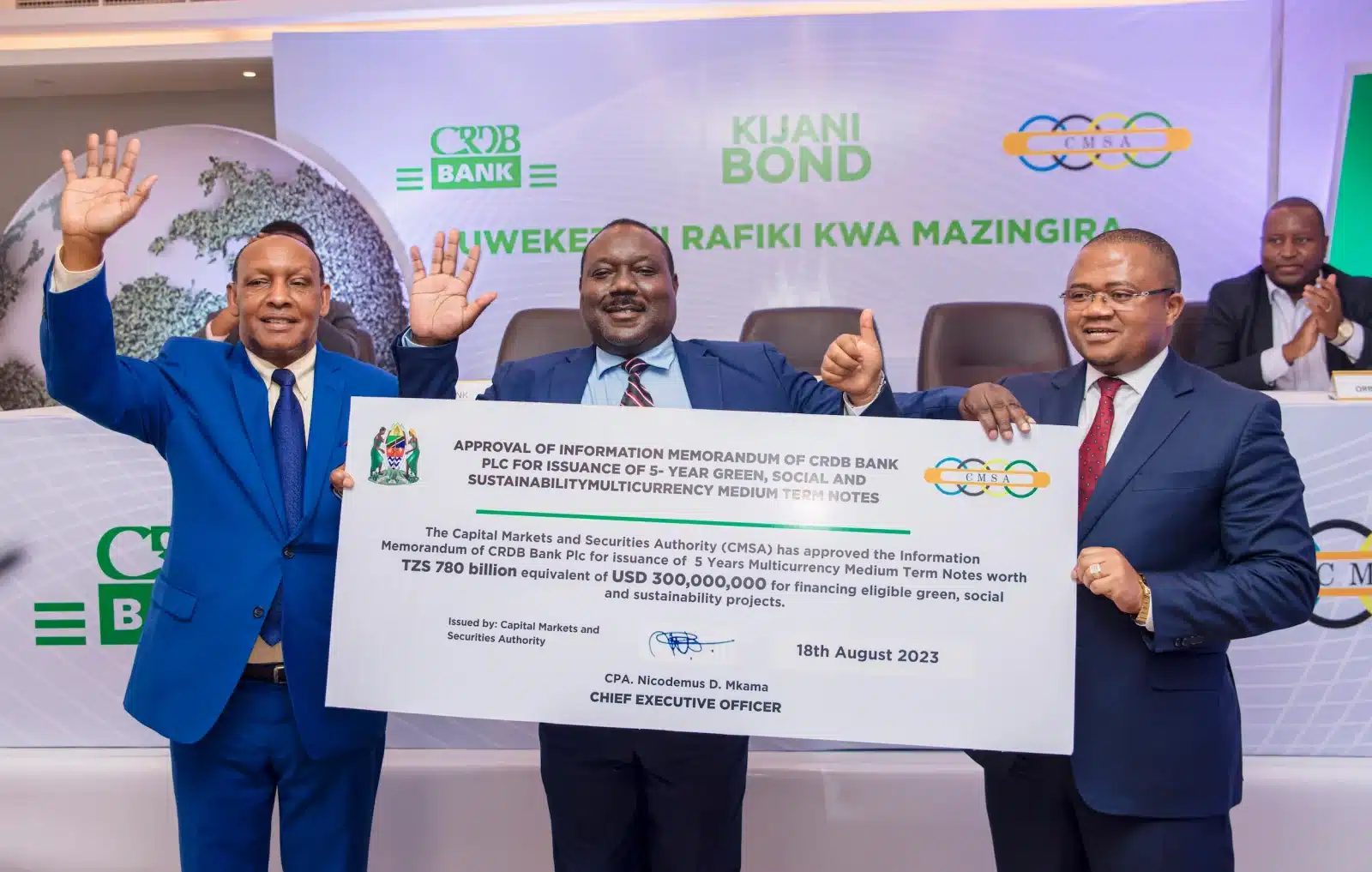
CRDB Bank hailed for Launching Kijani Bond with Unprecedented 10.25% Interest Rate: A Green Investment Opportunity for All

Dar es Salaam. 31st August 2023 — The Minister of State, President’s Office for Investment and Planning, Hon. Prof. Kitila Mkumbo, hailed CRDB Bank for ushering in a new era of sustainable investment through the launch of the pioneering Kijani Bond. This historic launch event took place today at the Serena Hotel in Dar es Salaam.

In his speech, Hon. Prof. Mkumbo acknowledged CRDB Bank’s role in providing local institutions a pathway to harness the transformative potential of green bonds. He highlighted the government’s dedication to fostering an enabling environment for investors by enhancing existing policies, laws, and regulations.

“CRDB Bank has already set an exemplary precedent,” he remarked. The issuance of the Kijani Bond, with its multi-currency Medium Term Note (MTN) Programme of USD 300 million, signifies a monumental stride toward realizing Tanzania’s National Financial Sector Development Master Plan 2020/21 – 2029/30, a strategic blueprint to empower both public and private sectors for the greater welfare of the people.

CRDB Bank’s Group CEO and Managing Director, Abdulmajid Nsekela, echoed the sentiment that the Kijani Bond is accessible to all, contrary to misconceptions. He affirmed, “This is an investment that even an average Tanzanian can partake in and benefit from, with a minimum initial investment of just TZS 500,000.” Nsekela underscored the unique proposition of the Green Bond: attractive investment yielding an impressive 10.25% interest per annum. He emphasized the unparalleled stability of this investment, insulating investors from market fluctuations.

The launch of the Green Bond is intrinsically linked with the offer opening, spanning from August 31 to October 6, 2023. Subsequent to this period, the bond will be listed on the Dar es Salaam Stock Exchange (DSE). CRDB Bank anticipates raising TZS 40 billion (with a green shoe of up to TZS 15 billion) during this first phase, which reflects the faith investors place in this innovative financial instrument. The Kijani Bond launch marks a historic moment as CRDB Bank introduces the largest green bond not only in Tanzania but across Sub-Saharan Africa.

“CRDB Bank has often been a pioneer,” remarked Dr. Ally Laay, CRDB Bank’s Board Chairman, who expressed deep gratitude to the Capital Markets and Securities Authority (CMSA) and other stakeholders who contributed to the approval of the green bond. Dr. Laay emphasized that both local and international investors have the opportunity to benefit from this bond, as it offers loans in Tanzanian Shillings or US Dollars.

The CEO of the Tanzania Capital Market and Securities Authority (CMSA), Nicodemus Mkama, lauded CRDB Bank for achieving this historic milestone and reaffirmed the alignment of the green bond with international standards. Mr. Mkama remarked, “We expect that Kijani Bond will be instrumental in further developing green financing in Tanzania.” The CMSA’s endorsement underscores its confidence in CRDB Bank’s commitment to sustainable financing and sets the stage for significant growth in climate financing.

Evans Osano, Director, Capital Markets, FSD Africa, said: “The issuing of this trailblazing green bond demonstrates that Tanzania’s rapidly expanding green economy presents huge opportunities for investors, both international and domestic. As the first green bond to be issued in Tanzania, it is also a major moment for the sustainable finance agenda in Africa and we are proud to have been able to provide the technical assistance.”

FSD Africa is providing technical assistance in Kijani Bond issuance, while Stanbic Bank assumes the pivotal role of lead underwriter and book runner for the forthcoming green bond issue, with Denton Tanzania Law Chamber providing legal advisory services. Orbit Securities Tanzania serve as the sponsoring broker, KPMG is entrusted with the responsibilities of the reporting accountant, and Sustainalytics provides a second party opinion.

The Kijani Bond has garnered the attention of global investors, including The International Finance Corporation (IFC), a member of the World Bank Group. IFC intends to invest 40% of the total issuance, USD 300 million.

To invest in the Green Bond, individuals can visit any CRDB Bank branch or authorized broker. Investment forms are available on CRDB Bank’s official website www.crdbbank.co.tz, and inquiries can be directed to the Customer Service Center via the toll-free number 0800008000.

The issuance of the Kijani Bond demonstrates CRDB Bank’s dedication to environmental, social, and governance (ESG) principles, strengthening its position as a key player in green financing. With a history of sustainable initiatives and recognition from the United Nations Green Climate Fund (GCF), CRDB Bank continues to lead the way in fostering green finance solutions.


FSD Africa Investments injects £10m into InfraCredit to support Nigeria’s Sustainable Climate Infrastructure

1st August 2023, Lagos – FSD Africa Investments (FSDAi), in collaboration with InfraCredit, have invested £10m into a first-of-its-kind risk-sharing backstop facility, designed to unlock local currency funding for sustainable infrastructure development in Nigeria.

The Risk Sharing Backstop Facility (RSBF) will address the challenge of low credit enhancement by mobilising local institutional investment via bonds into viable early-stage or green-field climate-aligned infrastructure projects.

By increasing the accessibility of finance for the “climate-aligned” infrastructure projects, the facility will help Nigeria accelerate her social and economic development, green economic transition as well as deliver on its climate goals.

Backed by the UK International Development through the Foreign, Commonwealth and Development Office (FCDO), FSDAi is pleased to be undertaking this £10m investment in partnership with InfraCredit – an established player in the sustainable infrastructure financing space.

InfraCredit’s current investments and project pipeline demonstrates the breadth and variety of projects this facility will support, with projects ranging from distributed renewable energy services for urban residences, to commercial and industrial renewable projects, edge-certified green housing and e-mobility infrastructure.

The RSBF will raise funding in series, initially from FSDAi, and eventually from other funders – aiming to reach a total capital base of up to US$50m.This investment therefore aligns with one of FSD Africa’s primary objectives – developing capital markets by tackling blockages in the system

UK Foreign Secretary, James Cleverly MP said:

 This investment further demonstrates the UK’s commitment and contribution to Nigeria’s transition to clean energy and builds on decades of UK leadership in mobilising support for climate-related infrastructure challenges.”

“Just like the successes of British International Investment (BII) and our Private Infrastructure Development Group (PIDG), I am optimistic that InfraCredit will continue to grow and mobilise even more private sector capital to invest in better, greener infrastructure.”

 Chief Investment Officer, FSD Africa Investments, FSD Africa, Anne-Marie, said: 

“FSDAi’s partnership with InfraCredit on the bridge-to-bond facility introduces a derisking financing solution to mobilize short and medium-term local institutional investment into critically needed infrastructure projects that are currently considered un-bankable without alternative credit enhancement.

 “Moreover, as Africa’s economies struggle to mobilise capital to develop key climate mitigation and sustainable power generation projects, this facility comes as a timely and much-needed intervention for Nigeria’s infrastructure landscape.’’

Chief Executive Officer, InfraCredit, Chinua Azubike, said: 

“I am delighted to work with FSD Africa Investments on an innovative facility which will support much needed but underfinanced projects realise their ultimate goals and purpose.

 “Smart use of catalytic capital can dramatically increase the role of private capital and local intermediaries in investing in Nigeria’s sustainable infrastructure space and help the country develop responses to the significant challenges which confront it from the deteriorating environment and ecology to an unstable energy mix and severe social inequality.” 

New report lays out urgent actions, that regulators can take to safeguard the new agenda for nature – key to Africa’s financial future

Nairobi, 25 July 2023: A new report from the collaborative forum of African financial institutions the African Natural Capital Alliance (ANCA) and management consulting firm Oliver Wyman has underlined the growing importance of African regulators acting on nature-related risks in line with their mandate of maintaining financial stability.

The report “Improving the transparency of nature-related risks in Africa: the emerging regulatory agenda”, outlines how financial sector stakeholders, including regulators, are increasingly recognising that the depletion of nature poses risks to financial and economic stability.

The report makes clear that the issue is a particularly urgent one for sub-Saharan Africa as its economies are disproportionately dependent on nature. For instance, over 70% of people living in the region are dependent on forests and woodlands for their livelihoods, compared to about half of the total world’s GDP generated in industries that depend on nature. The rate at which nature in Africa is being lost also exceeds the global average. For example, Africa’s Biodiversity Intactness Index (BII) score – which measures the number and abundance of species on land – declined by 4.2% between 1970 and 2014, considerably higher than the global BII score decline of 2.7% over the same period.

In East Africa alone, failure to protect natural capital as a whole (including its stocks of soil, air, water, and all living things, which underpin the region’s economy and human well-being) would result in an economic loss of more than $11.3 billion a year, according to an assessment commissioned in 2021 by USAid.

Dorothy Maseke, the Nature Lead at FSD Africa and ANCA, says: “Enhanced transparency of nature-related risks is fundamental to managing them effectively. This is the case for individual financial institutions, which need visibility of the nature-related risks in their lending, underwriting, and investment portfolios. And it is also the case for regulators, so that they can identify nature-related risk concentrations for regulated entities and assess whether they are being managed effectively.”

African regulators embracing this complexity is so important, she adds, because the continent is disproportionately exposed to nature-related risks.

Sandra Villars, senior advisor at Oliver Wyman, says: “The Global Biodiversity Framework (GBF), which was adopted in December 2022 by 188 governments across the world, aims to address biodiversity loss, restore ecosystems, and protect indigenous rights. This landmark agreement prompts governments to introduce policies to manage nature loss, which will lead to regulators having to act, and highlights the opportunities for regulators to do so proactively.

African regulators could thus benefit from engaging with this new agenda early and being at the forefront of integrating nature into their regulatory regimes.”

As summarised in the report, there are four simple steps regulators can take as part of a nature-related disclosure roadmap while policy frameworks are being finalised in their jurisdictions:

  1. Engage with finance and environment ministries to align their regulatory approach with
  2. government’s policy agenda on nature
  3.  Assess internal capacity and act on gaps
  4.  Assess the capacity for action among regulated entities
  5.  Engage in voluntary nature networks such as the Sustainable Insurance Forum (SIF), the Network for Greening the Financial System (NGFS), the African Natural Capital Alliance (ANCA), and the Task Force on Nature-Related Financial Disclosures (TNFD)

Transform Health Fund raises $50m to scale proven innovative healthcare models in Africa

7th June 2023, NAIROBI – FSD Africa Investments, AfricInvest, Malaria No More, and Health Finance Coalition (HFC) have announced the establishment of the Transform Health Fund (THF), a blended-finance fund for scaling proven and innovative healthcare models in Africa. THF has received commitments of $50 million reaching its target size for its first close.

The fund aims to respond to the critical healthcare financing gap in Africa while building a resilient healthcare ecosystem that improves access, affordability, resilience, and quality of healthcare for low-income patients. It will target three critical areas serving low-income patients: supply chain transformation, innovative care delivery, and digital innovation.

THF’s investments will target countries across sub-Saharan Africa, with a focus on East, Southern, and Francophone West Africa. This investment is designed to contribute to addressing the acute need for quality and affordable healthcare across the continent.

THF’s investment strategy explicitly targets health services for women as one of its main investment objectives. Some of its investments are constructed with a strong gender lens, targeting women-led businesses and serving increasing numbers of women.

Anne Marie Chidzero, Chief Investment Officer, FSD Africa Investments said: “FSDAi is excited to announce its catalytic capital investment in the innovative THF fund. We are proud that our capital contribution to this tranche of the fund facilitated the participation of other commercial and corporate private sector investors. Partnering with AfricInvest, HFC and the additional fund participants to strengthen the African healthcare system, particularly in a time of environmental stress and unpredictable climate events, is a high priority for FSDAi.”

Louise Walker, Head of Private Sector and Capital Markets Department, FCDO said: “The UK is excited with FSDAi to be a catalytic investor in the Transform Health Fund. This is an innovative partnership that brings together concessional and private finance which will in turn mobilise more capital, critical to making healthcare more accessible to and more affordable for low-income patients across the continent. I’m particularly pleased to see that investments will target women-led businesses and services will also focus on women, where we know maternal and infant mortality in Sub-Saharan Africa is well above SDG goals.”

AfricInvest, with its three decades of expertise and insight, will play a critical role in leveraging a wide range of support throughout many regions of the continent, providing financing for companies in the health sector, helping African local markets to both scale up their own healthcare systems as well as creating regional champions.

“As health financing needs continue to grow and healthcare demands increase, it is a critical we work toward closing Africa’s massive health financing gap,” said Martin Edlund, CEO, Malaria No More and Executive Director of the Health Finance Coalition. “The Transform Health Fund serves a vital role in catalyzing capital to scale healthcare solutions.”

THF’s partners include Royal Philips, Merck & Co., Inc., known as MSD outside of the United States and Canada, the U.S. International Development Finance Corporation (DFC), U.S. Agency for International Development (USAID), International Finance Corporation (IFC), Swedfund, FSD Africa Investments, Netri Foundation, Anesvad Foundation, Grand Challenges Canada (with funding from Global Affairs Canada), Chemonics International, and MCJ Amelior Foundation. The fund is expected to attract additional investors who share the goal of improving healthcare in Africa.

Morocco’s Ministry of Economy and Finance launches new study

Morocco’s Ministry of Economy and Finance launches new study – alongside FSD Africa – exploring financing options for small and medium sized enterprises in Morocco’s burgeoning Green Economy

  • Morocco’s small and medium-sized enterprises (SMEs) businesses represent 93% of all companies in the country and employ over 46% of its workforce which generate only 40% of the nation’s gross domestic product (GDP) and 31% of its exports.
  • SMEs are expected to play an important role in delivering Morocco’s Nationally Determined Contributions (mitigation and adaptation will require USD 38.8 billion and USD 40 billion, respectively), with around 40% of the mitigation actions and 55% of the adaptation actions to be implemented by SMEs either directly or through subcontracting to large enterprises (LEs).

Flagship research provides estimates of Morocco’s substantial green economic opportunity – as well as its alignment with the country’s efforts to address Nationally Determined Contributions – and explores the provision of green finance to SMEs so critical to the sector’s growth.

 Rabat, 23 May, 2023 – Morocco’s Ministry of Economy and Finance (MEF), alongside partners at FSD Africa and at the British Embassy in Morocco (Foreign Commonwealth Development Office), has commissioned a study that surveys the accessibility and diversity of financial assistance available to SMEs and MSMEs in Morocco, and the capacity of these businesses (which represent 93% of all companies int eh country, and employ 46% of its workforce) to accelerate Morocco’s transition to the green economy.

The provision of green financing has risen to prominence in the Kingdom, with several offers emerging in the last few years to support green projects. From public institutions mandated to support Moroccan business, to regional and continental development finance institutions and local commercial banks, there is an increasingly sophisticated eco-system of players able to – via debt, equity and grants – stimulate the growth of small, innovative Moroccan enterprises. The growing demand for green finance instruments creates a residual financing gap that needs to be addressed by innovative financing schemes.

The study concludes that the country’s commitment to sustainable finance growth will require coordinated effort from various stakeholders. Following the publication of this study, FSD Africa will outline the design and implementation of a new financial instrument that will increase the availability and accessibility of green financing for Morocco’s SMEs. In line with the updated Moroccan Nationally Determined Contributions (NDCs), SMEs are expected to play an important role in delivering Morocco’s Nationally Determined Contributions (NDCs), with around 40% of the mitigation actions (USD 15.5 billion) and 55% of the adaptation actions (USD 22 billion) to be implemented by SMEs either directly or through subcontracting to large enterprises (LEs).

Commenting on the project, Madam Minister of Economy and Finance, Ms. Nadia Fatah, added: “We are delighted to note the relevance of this study covering an analysis of supply gaps and needs of green financing targeting SMEs for the design a new instrument that could respond to the unmet demand of SMEs in terms of green financing. Indeed, this work comes at the right time to support the efforts undertaken to implement the Kingdom’s strategic orientation aimed at making sustainability a pillar of development. In this regard, we would like to acknowledge the support of British cooperation in carrying out this study.”

UK Ambassador to Morocco, Simon Martin noted: “In March 2023 the United Kingdom published its updated Green Finance Strategy. It emphasises the growth opportunity the transition to net zero represents for businesses, SMEs in particular, and the need for dedicated support to back them up. It further highlights how FSD Africa’s work in Morocco is already helping to stimulate capital flows in support of green economic growth. I am delighted that with this new study, we are able to take the next step in supporting Morocco’s flourishing green economy and expand our bilateral financial cooperation further.”

FSD Africa CEO, Mark Napier, added: ‘’Morocco’s potential as a green economy is extremely promising, but it’s critical that the country’s economic backbone – small and medium sized businesses – is encouraged and supported in their efforts to engage in green projects and activities. Only by devising a system of green financing can the Kingdom’s green aspirations be achieved. This study constitutes an important and timely intervention which, we hope, will stimulate discussion among policymakers, legislators, private capital, and other stakeholders.”

Emerging from the GAP analysis was a clear picture of areas requiring action within the green finance space. Certain key industries – such as construction, transport, electricity production – have a high greening potential but are underserved by green lines of credit, whereas areas such as agriculture are well catered for. Moreover, the study concludes that key sectors such as fishing and sustainable housing remain virtually untouched by green finance offerings and must be addressed. Finally, the research points to a lack of key instruments such as green insurance and guarantee products, or equity funds exclusively designed for green activities.

The study makes a series of recommendations, in areas ranging from public awareness to regulation and tax, technical assistance and technology, among others.

FSD Africa Investments backs Africa Climate Ventures

The investment represents the first institutional backing for the venture builder, which aims to assemble a portfolio of businesses focused on climate action across Africa, boosting continental participation in global carbon markets.

22 May 2023, Nairobi – FSD Africa Investments (FSDAi) has invested £1 million in Africa Climate Ventures (ACV), a pioneering venture builder working to build a US$45 million portfolio. ACV will catalyse the carbon asset class in Africa by building innovative businesses focused on solving our generation’s greatest challenge and at the same time capturing a significant share of global carbon markets in Africa. The venture represents a series of “firsts” in Africa: from its entirely Africa-based founder team and its permanent capital structure based in Kigali, to its exclusive focus on carbon mitigation, capture and removal, the continent’s fastest evolving sector.

ACV represents a historic evolution in Africa’s carbon ecosystem and will contribute directly to capital mobilisation in climate action. Indeed, by 2030 ACV aims to eliminate one million tonnes of carbon every year while improving the lives of 50 million Africans and creating at least 5,000 jobs on the continent.

The venture builder features a peerless bench of experienced Africa-based founders with a record of pioneering innovation on the continent and championing disruptive enterprises. James Mwangi is a 2022 Climate Breakthrough Award Winner and the founder of the Climate Action Platform for Africa, a non-profit organization that aims to help Africa achieve broad-based economic growth through climate action leadership. James is best known as a co-founder of Dalberg Advisors, the firm’s first elected Global Managing Partner and then Dalberg Group’s Executive Director. Mohamed Cassim is a South African investor best known as an angel investor, the Chair of MFS Africa Board, and the Founder of Abacus Advisory. CJ Fonzi was also a Partner at Dalberg Advisors, with the firm for over a decade he served as the Group Director of Innovation and then founded Dalberg’s Rwanda business in 2017.

This team is working to build a portfolio of climate positive businesses across Africa, with the ultimate aim of launching and scaling 15 ventures in the next four years. ACV is seeking to build this portfolio by investing to: i) bring proven global climate technology to Africa, ii) accelerate and de-risk the continental expansion of technologies and business models that have gained traction in one or a few African market(s), and iii) add carbon revenue streams to existing African businesses with the potential to scale climate positive solutions.

ACV has adopted a structure more in-line with a global north venture studio in which the vehicle is structured as a permanent capital vehicle which sells equity rather than securing fund management mandates. This has allowed ACV to begin building ventures in parallel with fund raising, which the founders believe is paramount given the urgency of climate change, and the need for Africa to quickly establish itself as part of the solution.  There are already two ventures in the portfolio: KOKO Networks Rwanda, a co-venture between ACV and KOKO Networks which already provides sustainable bioethanol cooking fuel to over 900,000 Kenyan families and aims to reach a million Rwandan families by 2027, and Great Carbon Valley, a Kenya based developer of direct-use clean energy applications currently focused on developing a direct air capture and permanent carbon storage site in Kenya.

ACV’s pipeline of further opportunities demonstrates the breadth and versatility of the venture builder. They range from biochar and enhanced rock weathering technologies, to biodigester and e-mobility businesses, to harvesting carbon revenue for green growth across the portfolio of a well-established continental private equity fund. These are businesses and technologies which have the capacity to transform African economies and make a meaningful difference in climate change but they require risk capital and hands on venture builders to scale, attract further investment, and reach their potential.

FSDAi’s investment in ACV takes the form of a convertible loan of £1 million to support the venture builder’s formalisation and build additional ventures as demonstrations to attract investment from larger funds. On top of this investment, FSD Africa will provide £75,000 in grant funding to support the development of premium carbon credits and the marketing of portfolio and pipeline companies. Moving forward, FSDAi has secured the right to invest up to £8 million in ACV’s planned 2024 close.

FSDAi is the investment arm of specialist financial development agency FSD Africa which receives funding from the UK government and provides tools and resources to drive large-scale change in financial markets and support sustainable economic development. ACV is the latest in a series of investments by FSDAi in innovative green investment vehicles including Persistent Energy, a leader and pioneer investor in the off-grid energy and e-mobility sectors in Sub-Saharan Africa, and Nithio, which invests in renewable off-grid energy.

FSDAi has committed to support ACV on the basis that its activities will actively contribute to Africa’s transition to net-zero, the promotion and acceleration of the continent’s green sector, and the creation of quality, skilled jobs (around 600 will be created via this initial £1 million investment) in a strategically vital sector. Ultimately, FSD Africa believes that ACV can help the continent’s businesses participate in global carbon markets and capitalise on the continent’s unrivalled capacity for profitable climate-smart businesses. Moreover, FSDAi’s investment aligns with the emerging priorities of African policymakers who will gather in Kenya in September at the Africa Climate Summit to co-ordinate a unified, collective pan-African approach to the discussions at the next COP in Dubai.

Anne-Marie Chidzero, CIO of FSD Africa Investments, said: “In backing the ACV partners, FSDAi sees a tremendous opportunity to galvanise global investment and finance to promote Africa’s status as the pre-eminent climate investment destination.’’

James Mwangi, CEO of Africa Climate Ventures, said: We are thrilled that FSDAi has joined us in building ACV.  The involvement of FSDAi has already been invaluable in refining the ACV model. As we work towards ambitious objectives, we believe FSDAi will be a key partner in ensuring our success.”

Rachel Turner, Director, International Finance, Foreign, Commonwealth & Development Office, said“We are excited to be supporting this enterprising partnership between FSD Africa and ACV. The need to mobilise climate finance for Africa has never been greater, and this can’t happen without innovations that can build the pipeline of opportunities to absorb and deploy capital into productive, sustainable and inclusive uses. Tapping into the developing carbon market ecosystem represents a significant opportunity for Africa to raise capital at affordable terms whilst contributing directly to the climate challenge. This partnership with an impressive African team is pioneering in its approach.”

Regulations for insurance sandbox to deepen innovation, financial inclusion in Nigeria

May 17th, 2023, Lagos – In a strategic move to deepen insurance penetration and financial inclusion through innovation in Nigeria, the National Insurance Commission (NAICOM) has released the insurance regulatory sandbox operational guidelines.

The guidelines are designed to determine insurance solicitation or distribution within the insurance value chain, facilitate insurance products; underwriting; policy & claims servicing, etc., before making them public.

The Insurance Regulatory Sandbox Operational Guidelines include Market Conduct Guidelines for Takaful and Retakaful Insurance Operators and Enterprise Risk Management Framework for Takaful and Retakaful Operators in Nigeria.

Takaful Insurance is generally based on the concept that the negative impact of a specific incident is distributed among a group of persons instead of making the person who experienced the loss bear its results alone. The means to achieve this is to establish a common fund to which everyone exposed to a specific risk may contribute in such a way that indemnity will be paid from that fund.

Retakaful is the Islamic alternative to conventional reinsurance and operates on Shariah principles. It is a way for a primary insurer to protect against unforeseen or extraordinary losses.

FSD Africa supported by the UK government has been providing technical support to NAICOM to enhance its ability to fulfill its development, regulation, and supervision mandate to support market development, market stability promoting innovation, and protection of policyholders in line with international standards.

The launch of the regulatory sandbox is part of the NAICOM’s strategic objective to drive innovation of products and services, and ensure operators are professional in the conduct of their businesses and in line with best practices.

Commenting on the launch of the regulatory sandbox:

British Deputy High Commissioner in Lagos, Ben Llewellyn-Jones said:

“Insurance remains a critical tool in building the resilience of businesses, livelihoods, and households globally. With the persistence of climate risks / disasters and fluctuating economic realities in Nigeria, it is more important for the insurance industry to leverage innovation to develop more contextualised products and services that would mitigate the risks for Nigerians and their businesses.

“The UK government is keen to see this innovation delivered in consultation with the insurance industry and regulators to maximise the usefulness and impact of this tool.”

Director, Risk and Resilience, FSD Africa, Kelvin Massingham said:

“It is vital for NAICOM to balance the need to facilitate and promote innovation with the protection of consumers and the adequate management of the risks that may arise. Support on market development focusing on regulating for innovation, will establish an environment that responds to innovation and market changes on an ongoing basis by building internal capacity, instruments and re-shaping their engagement with the private sector to foster a culture of innovation, learning and testing innovations.”

Another guideline released last week by NAICOM was the Enterprise Risk Management (ERM) Framework which is intended to establish minimum Risk Management Standards for Takaful Insurance Operators (TIOs) in Nigeria.

Under this guideline, all Takaful Insurance undertaking will henceforth establish and maintain a sound ERM Framework to support the adequacy of its solvency and comply with all relevant Sharia rules and principles.

This framework is expected to be “comprehensive in nature, dealing with all reasonably foreseeable and relevant material risks of the funds making up the Takaful Undertaking, and shall be formalized through a set of policies, consistently applied, the TIO’s approach to determining the appetite for risk, its process for managing risks and its Governance related to risk.