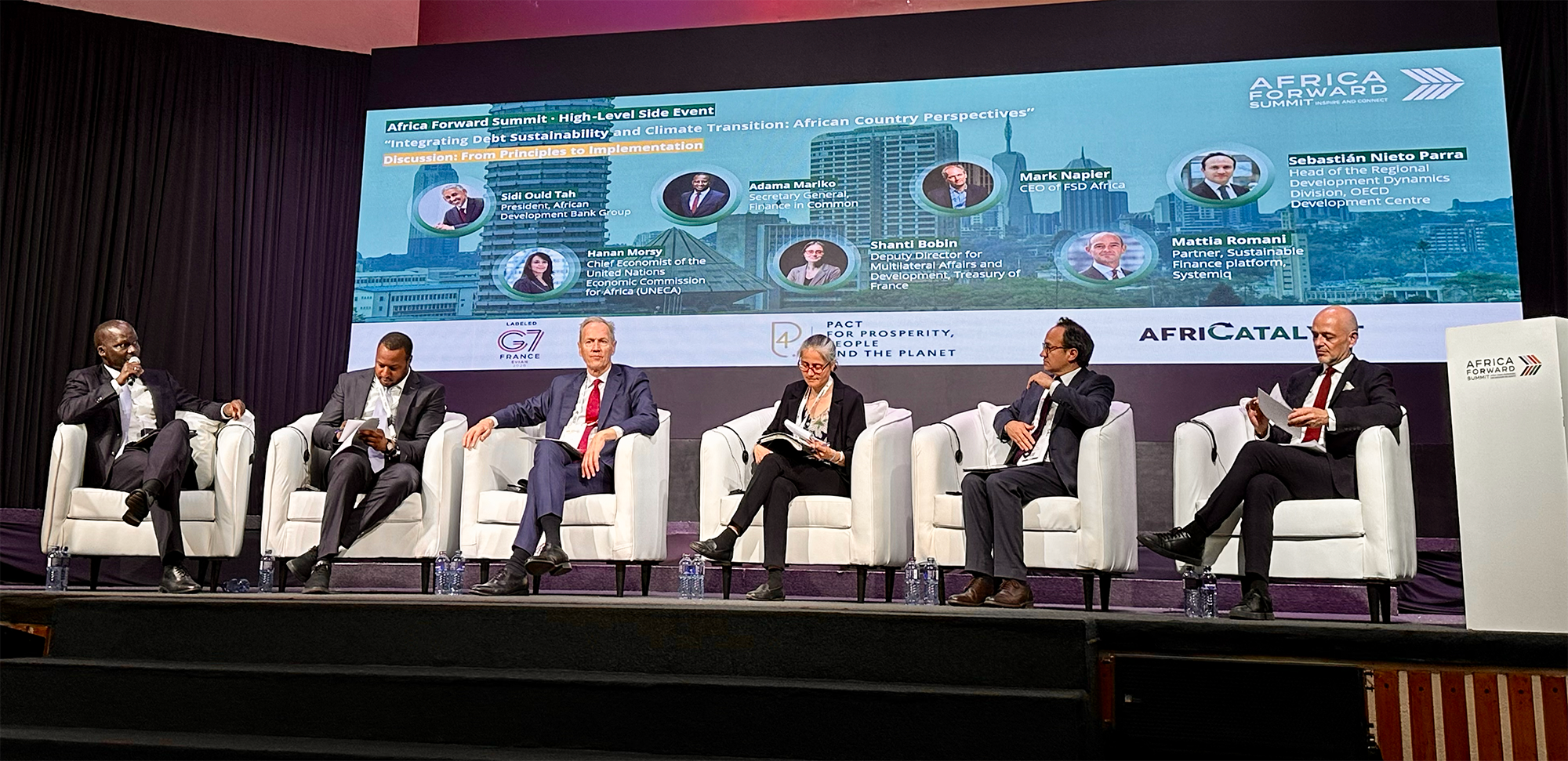
L – R: Adama Mariko , Mark Napier of FSD Africa, Shanto Bosin of Treasury of France, Sebastián Nieto Parra of OECD and Mattia Romani of Systemiq at the Africa Forward Summit in Nairobi, Kenya on 11 May 2026. Photo FSD Africa/Mireille Ferrari.
Nairobi, Kenya – African countries are under growing pressure to manage debt, respond to climate shocks, and continue financing development despite shrinking fiscal space.
These challenges were at the centre of discussions during a high-level session at the Africa Forward Summit in Nairobi held on 11 May 2026, where policymakers, development finance leaders, and international partners explored how debt sustainability and climate resilience can be better integrated into development planning and financing frameworks.
The side event, titled “Integrating Debt Sustainability and Climate Transition: African Country Perspectives,” was jointly convened by the Pact for Prosperity, People and the Planet (4P) and AfriCatalyst. Discussions focused on practical reforms that could help countries invest in resilience and development without worsening fiscal pressures.
Opening the session, Moussa Faki, 4P Special Envoy, stressed the importance of creating spaces where countries can share lessons and shape solutions based on their own experiences, while helping countries navigate increasingly fragmented debt and climate financing systems.
Rwanda highlights the importance of climate-informed financing
A recurring message throughout the discussion was that African countries are not simply asking for more finance, but for financial systems better aligned to their realities.
Drawing on Rwanda’s experience, Claudine Uwera, Senior Strategic Advisor to the Prime Minister of Rwanda, highlighted how innovative financing tools can help countries invest in resilience without undermining fiscal stability.
“Fiscal responsibility and climate resilience are not competing priorities,” she said.
We need to build economies that are resilient, stable, and sustainable for the future.
Uwera pointed to Rwanda’s use of sustainability-linked financing and risk-sharing mechanisms, including a EUR 200 million credit guarantee facility, as an example of how blended finance approaches can mobilise investment while reducing pressure on public resources.
Mobilising domestic and private capital
Much of the discussion focused on the role domestic capital markets and private capital must play if African countries are to finance infrastructure, adaptation, and economic transformation at scale.
Mark Napier, CEO of FSD Africa, said governments across the continent are operating under severe fiscal constraints, making it impossible for public finance alone to meet development and climate investment needs.
Governments are so stretched for cash they can’t fund the things we’d like them to fund
Napier argued that debt sustainability directly affects both the availability and cost of capital, limiting countries’ ability to attract investment into productive sectors. He called for stronger support to help countries navigate guarantees, insurance products, and other risk-sharing instruments.
“There is a lot that is there,” he said.
But it’s really complicated. Knitting all that together requires support on the demand side.
Using Nigeria as an example, Napier noted that while pension and institutional capital pools are growing, around 60% remains invested in government securities, while only 1.2% is directed toward infrastructure.
“We have to get away from that,” he said, arguing that deeper capital markets are essential if African economies are to finance long-term resilience and growth.
Climate resilience must be built into financial systems
Several panellists stressed that debt and climate discussions cannot focus only on financing instruments, but must also address institutional capacity and long-term planning.
Shanti Bobin, Deputy Director for Multilateral Affairs and Development at the French Treasury, argued that climate resilience and development should be viewed together from the outset of debt planning and investment decisions.
“Climate and development are two sides of the same coin.”
From the OECD Development Centre, Sebastián Nieto Parra highlighted the need for stronger debt management, better regulation of sustainable finance instruments, and improved information systems to help reduce the cost of capital facing African countries. He also warned that declining official development assistance will make partnerships and technical assistance increasingly important.
Better recognising the value of adaptation and resilience
Mattia Romani, Partner at Systemiq, argued that global financial systems still struggle to properly value investments in adaptation and resilience.
We are good at assessing and reducing risk on debt sustainability,” he said. “But when it comes to adaptation and resilience, we are not ready in reflecting that value.
Drawing on Systemiq’s work with Uganda, Romani explained how climate preparedness and resilience planning can help send stronger signals to investors and financial institutions over time.
From discussion to implementation
Closing the session, African Development Bank President Dr Sidi Ould Tah spoke about the African Financial Stability Mechanism, a shared continental financial safety mechanism intended to help African countries manage financial shocks, strengthen financial stability, and reduce the high borrowing costs many continue to face in global markets. The mechanism echoed many of the themes raised throughout the discussion, particularly the need for African-led financial solutions that can help countries navigate debt pressures while continuing to invest in resilience and development.
Throughout the discussion, speakers repeatedly returned to the gap between the financial tools available globally and the realities African countries are managing on the ground, from climate vulnerability and constrained fiscal space to the high cost of capital and limited room for long-term investment.