Category: Blog

Are refugees viable customers for banks?

Refugees are not an obvious customer segment for financial service providers (FSPs). It is not hard to see why: in a world where refugees are too often portrayed as very poor, vulnerable, with few tangible assets and little stability, where are the incentives to enter such a challenging market?

While FDPs often are vulnerable, poor, and burdened with instability, through a different lens they can present an intriguing opportunity. In places like Rwanda, large refugee camps can exist for decades and are home to vibrant micro-economies. Moreover, many FDPs fit the basic profile to access formal financial services; they have regular income, formal identification, and a need for financial products.

A study conducted by BFA Global in partnership with FSD AfricaAccess to Finance Rwanda[1] (AFR), and UNHCR last year suggests that there are good reasons to believe that forcibly displaced persons (FDPs) can be a profitable customer group for FSPs.

Demand: Refugees Need Financial Services

Many refugees not only receive aid, they also earn income, thereby creating sufficient cash flow to drive demand for financial services.

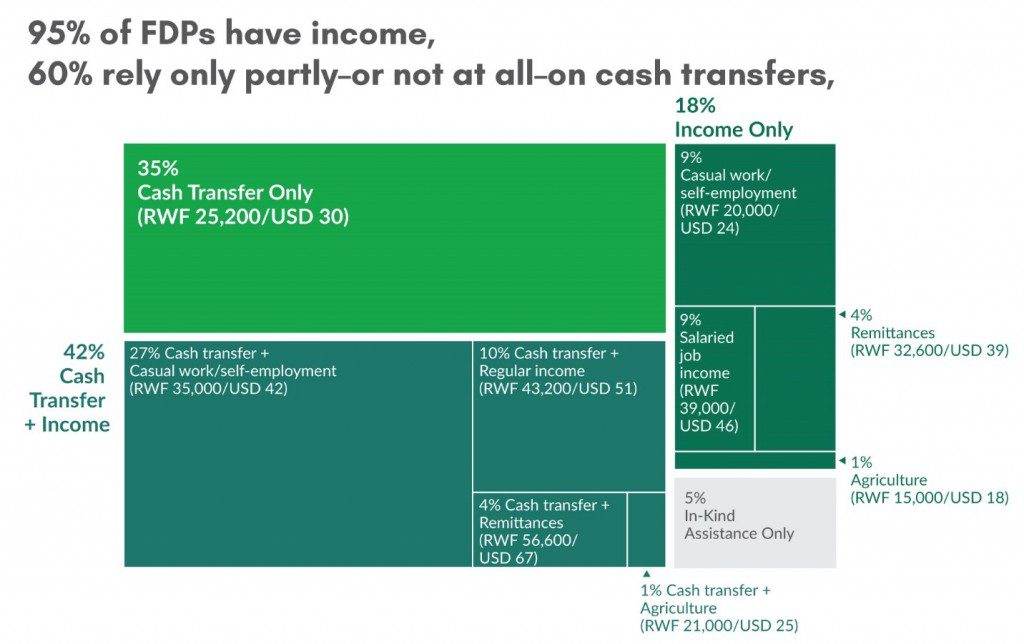
Although they are plagued by instability and insecurity, many refugees start businesses and some also have jobs. About a third, or 27% of refugees, are self-employed, providing services such as dressmaking and barbering largely within the camp. An additional 10% of refugees earn a monthly salary from employment. Finally, 4% receive remittances.

 In addition to the income earned from work, 95% of refugees receive humanitarian aid in the form of monthly cash transfers. The World Food Programme (WFP) and the UNHCR are shifting from providing refugee households with in-kind humanitarian support to giving them cash.  At the time of our study, refugee households in four out of the six camps in Rwanda were receiving monthly cash transfers. The other two camps were soon to migrate from in-kind to cash transfers.

With these regular inflows of cash, refugees need a place to receive and store their money, creating a clear demand for secure financial services.

Supply: Refugees can be a profitable segment

Not only is there substantial demand for financial services, our analysis suggests refugees are a viable customer segment. Of the 160,000 men, women and children who are displaced in Rwanda, we estimate that about 44,000 adults have sufficient monthly cash flow to make them viable customers for FSPs, with additional opportunities for cross selling.

To start, the basic transaction accounts that banks offer other low-income Rwandans would likely be even more successful with refugees who have regular, stable cash flows. Moreover, accounts that refugees open to receive their monthly cash transfers are notlikely to become dormant or inactive, as is generally the case with many low balance accounts, making refugees a more attractive proposition for banks.

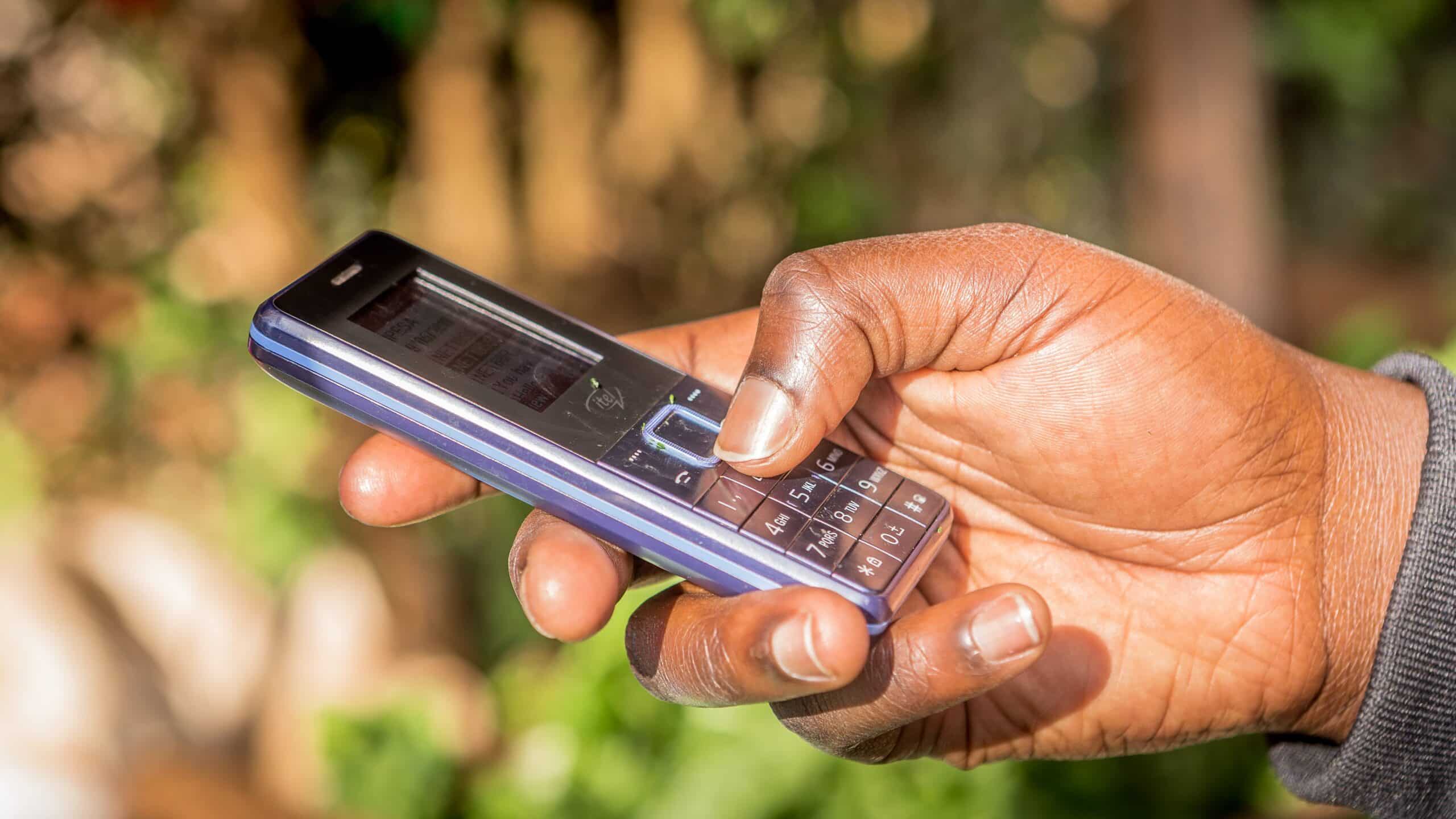
 In addition, there are opportunities for cost savings using mobile money. Although low-income households tend to use informal mechanisms such as savings groupto manage their finances, 90% of the refugees we interviewed use mobile money regularly and 95% already have experience using a bank account, thereby decreasing upfront training and client education costs.

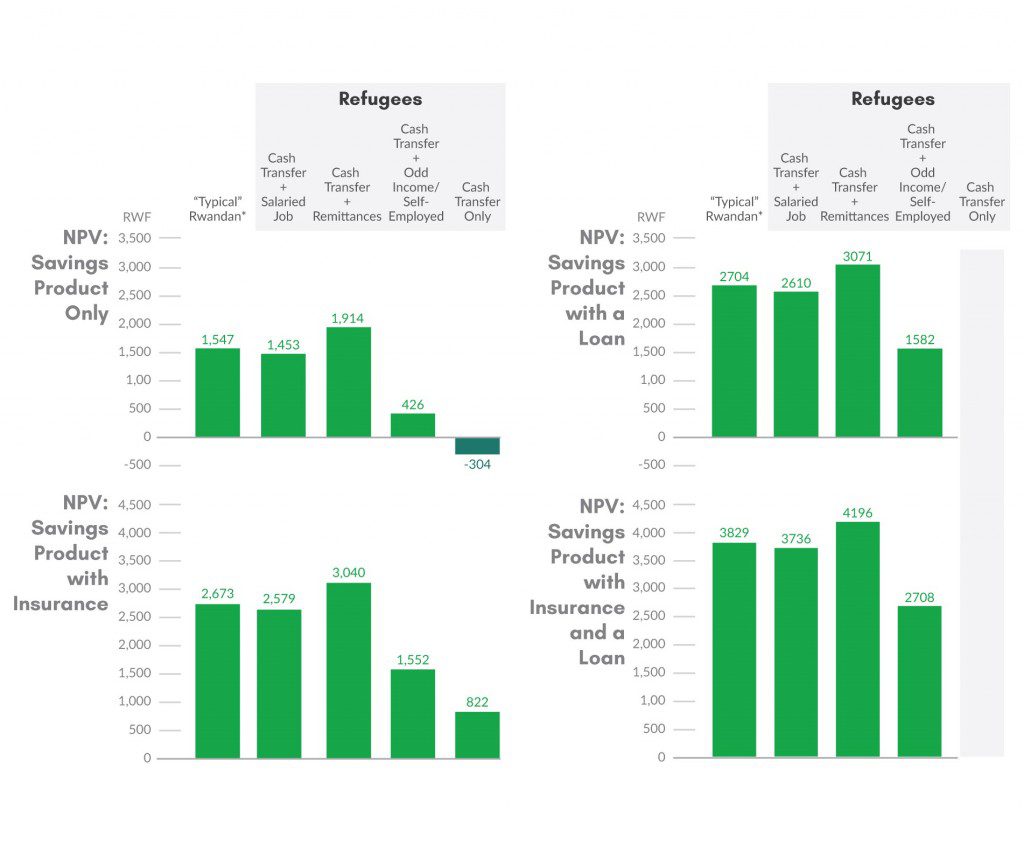
Finally, there are opportunities to cross sell other products although many segments are profitable with just a savings product. Our dynamic net present value model estimates FSPs can profitably serve refugees with salaried jobs, those who are self-employed, and those who receive regular remittances with only a savings proposition! In fact, we believe that these three segments, who together make up 41% of the adult refugee population, can be just as profitable to FSPs as typical low-income account holders in Rwanda.

That said, FSPs that offer only a savings product to refugees who depend solely on cash transfers are not likely to have a profitable proposition. Targeted cross-selling of other financial products, such as a loan or micro-insurance, will be needed to improve the FSP’s profitability for this segment.

Regulatory Environment: Refugees Qualify for Financial Services

Given the significant forces for demand and supply, the regulatory environment is the last piece of the puzzle. Fortunately, we found that refugees meet the formal requirements for opening a bank account in Rwanda.

Although most refugees do not have a government-issued ID card (which FSPs typically use for KYC purposes), all refugees have a proof of registration document issued by the Ministry of Disaster Management and Refugee Affairs. FSPs that want to serve refugees can request regulatory approval to use the proof of registration document to open accounts; the National Bank of Rwanda has approved such requests in the past.

Ultimately, our research suggests that FSPs shouldn’t be guided by the stereotypical narratives about refugees. We found that while refugees face difficult circumstances, they are also viable customers for FSPs that take an innovative approach to product design and customer acquisition.

As added incentive, in December 2017, FSD Africa launched an innovation competition to provide FSPs with ideas about how to bring financial access to refugees with grant funding of up to £160,000. The competition has received 21 concept notes to date.


[1]Rwanda is a signatory to the 1951 Convention relating to the Status of Refugees[1], which guarantees refugees the freedom of movement, right to work and other liberties and has been hosting refugees for over 20 years.

[1] BFA’s calculations based on the Maastricht Graduate School of Governance (2016) data set from a research conducted in May 20

On international women’s day, women save to succeed

This month, we celebrate International Women’s Day united in the 2018 theme “Press for Progress.” While much of the discussion is around how global actors are pressing for progress on women’s equality at the macro level, I’d like to take a deeper look at how a low-income woman presses for progress in her own financial life.

Our program, Financial Sector Deepening Africa (FSD Africa), funded by UK aid from the UK government, is supporting Women’s World Banking’s partnership with Diamond Bank in Nigeria to improve access and usage of savings accounts among low-income clients, particularly women.

Three years into this partnership, we’re starting to understand just how transformational saving with a formal institution can be for women.

Women’s World Banking’s global research shows that women have specific and often complex savings needs. They are juggling scarce resources to cover day-to-day expenses with an eye toward the future. They save against emergencies and toward goals such as education and business growth.

However, low-income women often face barriers to accessing a safe place to save due to mobility and time constraints as well as low levels of financial literacy. They are forced to save in less reliable ways: at home in a drawer or under a mattress, by buying excess stock for their businesses or through a neighborhood savings club.

In Nigeria, Women’s World Banking’s research revealed a strong savings culture. Women running businesses in the bustling urban markets of Lagos put aside as much as 60 percent of their daily income in informal savings tools such as ajo, adako and other methods. What was most surprising though—these women’s businesses were located literally steps from bank branches. Why were they not opening savings accounts?

The answer—the distance is emotional, not physical. These market women are familiar with banks yet they do not see them as relevant or accessible. Even those who have accounts usually place most of their money in traditional, though more informal, financial tools. Diamond Bank set out to close this gap by offering an innovative and relevant savings product that crosses the barriers preventing low-income Nigerians from accessing formal financial services.

Planting a Seed: A transformational savings account

The BETA (meaning “good” in pidgin English) account targets self-employed market women and men who want to save frequently (daily or weekly). The account can be opened in less than five minutes and has no minimum balance and few fees.

Because these clients, especially women, value convenience, the product is built around serving women in the market where they work. Agents, known as BETA Friends, visit a client’s business to open accounts and handle transactions, including deposit and withdrawal, using a mobile phone application.

With support from FSD Africa, Women’s World Banking and Diamond Bank are expanding on the BETA proposition to offer women more financial tools and services, including BETA Target Savers, a long-term savings account to help clients work toward larger goals.

Today, Diamond Bank has more than 520,000 new savings account holders who are using these valuable tools, more than 197,000 of whom are women. That’s more than a half million low-income clients who did not previously have access to Diamond Bank, a bank often just steps away from their businesses.

One woman client, who has BETA Friend agents visiting her market stall regularly to collect deposits, put it quite simply:

I want them to be coming around often so that I can save my money, so I can use it to do better things for myself.

With Target Savings, we’re hearing a similar sentiment. A woman client said,

You keep your money to achieve what you want to do. You keep in the back of your mind to achieve your goal.

When we look at how women are able to “press for progress” in their own lives, we know that true financial inclusion is not just about opening accounts, but meaningful usage of these accounts to achieve financial goals and build a better future. Women’s World Banking’s partnership with Diamond Bank is at an exciting phase of the project where we can start to understand just how transformational these savings accounts will be.

While we’re in the very early stages of analyzing the data, Women’s World Banking is looking at exactly how clients are doing this. After conducting a baseline survey in 2015 as well as a follow up survey in late 2017 to measure how clients are using the savings accounts to improve their lives, we are seeing promising early results, specifically in using savings to grow businesses and achieve goals.

Clients are reporting using their savings to fund business expansion. This is a critical point as financial services for low-income women are often associated with micro loans, and while credit is an important tool, savings is essential for women to grow their businesses.

Additionally, time and time again, when Women’s World Banking asks women about their primary savings goals, education for their children is at the top of the list. Initial survey results are showing that BETA clients are saving for their children’s education and are more likely to have all of their school-aged children in school.

On International Women’s Day, we’re happy to celebrate these promising signs of progress for women in Nigeria. We look forward to continuing to learn more about how savings tools can help women to press for progress.


This blog was published by Women’s World Banking http://www.womensworldbanking.org/news/blog/international-womens-day-women-save-succeed/

Savings groups and women’s financial inclusion

Join us in celebrating International Women’s Day 2018!

Through our #PressforProgress campaign, we are proud to share information about our partnerships that are supporting women’s economic empowerment in a variety of ways.


The SEEP Network is a collaborative learning network that supports strategies for vulnerable populations, especially women, to participate in markets and improve their quality of life. FSD Africa has partnered with SEEP to build and apply knowledge and evidence on savings groups in order to improve the ability of these groups to reduce vulnerability and enhance access to economic opportunities amongst their members, especially women and the rural poor.  Research shows that savings groups contribute towards women’s economic empowerment by expanding access to basic financial services and support networks. They serve as a means for women in marginalised environments to smooth out uneven cash flows and become more resilient to shocks.

To learn more on how saving groups have enhanced women’s financial inclusion, read this briefing note by David Panetta from the SEEP Network.

Women in financial inclusion policy advancement

Join us in celebrating International Women’s Day 2018!

Through our #PressforProgress campaign, we are proud to share information about our partnerships that are supporting women’s economic empowerment in a variety of ways.


The Fletcher School Leadership Programme for Financial Inclusion is an intensive and innovative executive education initiative for promising financial regulators and policymakers from emerging and frontier markets, including in sub-Saharan Africa. Through support from FSD Africa, the Bill & Melinda Gates Foundation and the MasterCard Foundation, the programme has trained financial regulators and policy makers, including 40% women, with many going on to develop and implement policies that address financial inclusion in their respective countries, including for women.,

Addressing the gender gap in fintech

Just as in technology and finance industries around the world, fintech companies in Africa are grappling with a severe under-representation of women in leadership roles and throughout their businesses. When compiling the data in the 2017 Fintech Talent Africa report, Digital Frontiers Institute (DFI) made gender balance a particular focus of the research, knowing that this is a significant problem in the industry.

The findings of the report validated this belief. More than 400 industry leaders and professionals responded to the survey and of these, only 12.5% were women. The gender gap was reflected again in the data they reported: respondents indicated that the teams they lead are made up of approximately 39% women, while senior or executive teams are made up of 43% women. This data highlights that there is still a way to go in order to achieve gender parity.

To learn more about addressing the gender gap in fintech, access the full blog via this link.,

Building women’s skills and capacity

Join us in celebrating International Women’s Day 2018!

Through our #PressforProgress campaign, we are proud to share information about our partnerships that are supporting women’s economic empowerment in a variety of ways.


The Strathmore Business School (SBS) is a renowned institution in East Africa that aims at developing transformative business leaders to tackle the various social and economic challenges facing Africa. With support from FSD Africa, SBS has developed and expanded its Leadership Academy in East Africa including creating a ‘Women in Leadership’ programme. The programme is targeted at women in management and equips women with skills to perform effectively and efficiently to achieve excellence in the various spheres of their lives.

Additionally, The Chartered Institute for Securities & Investment (CISI) through FSD Africa’s support, is providing skills development and training in order to strengthen professional standards among Capital Markets Professionals – women included. CISI is a professional body that offers a wide range of qualifications in the financial sector including Operations, Wealth Management, Compliance/Risk, Capital Markets/Corporate Finance, Financial Planning and Islamic F

Remittances as a source of income for women

Join us in celebrating International Women’s Day 2018!

Through our #PressforProgress campaign, we are proud to share information about our partnerships that are supporting women’s economic empowerment in a variety of ways.

Cenfri supports financial inclusion and financial-sector development through facilitating better regulation and market provision of financial services through research, advisory services and capacity-building programmes. FSD Africa and Cenfri have partnered on the Risk, Remittances and Integrity (RRI) programme which seeks to strengthen the integrity and risk management role of the financial sector and to facilitate remittance flows within and into the continent.

With respect to remittances, research conducted by Cenfri indicates that remittances are an important source of income for women in sub-Saharan Africa. They are used to meet monthly expenses, deal with unexpected shocks, and support family obligations (e.g. paying school fees).,

Women and digital financial services


Join us in celebrating International Women’s Day 2018!

Through our #PressforProgress campaign, we are proud to share information about our partnerships that are supporting women’s economic empowerment in a variety of ways.


The Digital Frontiers Institute is a one-of-a-kind institution that is building human capacity in digital financial services by equipping a new generation of fintech professionals with the information, skills and vision they need to deliver and guide society towards inclusive digital financial solutions. DFI recognises the under-representation of women in leadership roles in digital financial services and fintech as well as the general lack of financial inclusion for women across the world, particularly in sub-Saharan Africa. Through support from FSD Africa and other partners, DFI is addressing these issues by equipping women with the necessary qualifications and training to develop digital financial services and products that sustainably include them and that, in turn, allow women actively participate in the economy.,

Notes from the frontier: FSD Africa’s fragile states approach – a learning journey (

In early November, FSD Africa brought two worlds together for the first time: taking five prominent financial service providers (FSPs) to Gihembe Refugee Camp in Rwanda to participate in a ‘Financial Product Design Sprint’ in partnership with UNHCR, Government of Rwanda, and Access to Finance Rwanda (AFR). We were also joined by a member of UNHCR from Geneva, the International Finance Corporation and FSD Uganda.

Earlier that week, FSD Africa and BFA presented research on ‘Refugees & Their Money’ to over 20 FSPs in Kigali – highlighting the business case for financial products focused towards refugees (you can find a short summary found here). Philip Kakuru, from Tigo, said ‘With the limited access of the refugees, there was little to know about them, but the sprint design opened our eyes’. These FSPs, along with any others, now have an opportunity to win one of our four £10,000 grants in our Innovation Competition – Financial Services for Refugees in Rwanda.

To read more about the wider FSDA approach to refugee finance, take a look at last month’s blog here.

Day One: Any ideas?

The next day, the five FSPs, chosen through an open competition, began the Financial Product Design Sprint. The FSPs were a diverse group representing MMOs, MNOs, MFI and banks: MobiCash, Equity Bank, Vision Fund, Tigo and Commercial Bank for Africa. This three-day event hoped to challenge misconceptions about refugees, their potential and FSPs to consider a refugee product seriously. The first day began with an in-depth presentation of BFA’s research and details regarding the structure of refugee camps. This was followed by product brainstorming with each FSP, before narrowing down to a select two or three ideas which were fleshed out.

Day Two: What are the financial lives of refugees?

On the second day, these FSPs were taken to Gihembe Refugee Camp, a camp with a population of around 12,000 refugees from DRC and located only an hour drive from Kigali. Here, each FSP had the opportunity to speak to at least two refugees and over the course of two hours get a better feel for their financial lives. For most, this was their first time interacting with refugees and particularly in a refugee camp. As one FSP noted ‘With this segment, there is a lot to offer and learn from them’. This was followed by further prototyping of the FSP’s idea and customising their product to the needs of refugees.

Day Three: Is this the right product for refugees?

The final day offered an opportunity to return to the camp and with initial prototypes, in the form of a drawing, poster or app, get direct customer feedback. This proved particularly helpful for many FSPs to refine their product. As Peter Kawumi, from FSD Uganda, said ‘Through the design sprint’s customer interaction iterations, misconceptions about the refugees’ technology literacy, economic independence and financial ambition were debunked.’
The first ‘Financial Product Design Sprint’ was well received by all FSPs and there is also potential for replication in Uganda, with FSD Uganda, and as Vishal Patel from the IFC said ‘helped inform IFC’s work in Kenya in Kakuma refugee camp and town.’
Learning from risk taking

Working with banks and beneficiaries in this way is new to FSD Africa. It builds on the FinDisrupt model, pioneered by our sister organistion – FSD Tanzania. We learned a lot, especially on the value of bringing the refugee voice into FSD Africa planning and FSP business casing. The type of discussion it generates, out of the office environment, created momentum that would otherwise never have been achieved.

To read more about the wider FSDA approach to refugee finance, take a look at last month’s blog here.