Country: Ghana

Insurance for inclusive and sustainable growth – imperatives for action

Insurance has a strong role in combatting poverty and advancing development, in at least three ways:

Improving individual and household resilience
Insurance makes households more resilient in the face of financial shocks. Insurance also enables households to access services such as credit, health and education that may otherwise not be attainable to them.

Improving business resilience & productivity
Effective risk transfer is a fundamental part of corporate sustainability.
It also facilitates exports and imports, enables foreign investment and helps to ensure access – at better terms – to business financing.

Developing the demand and supply of capital
Insurance mobilizes capital through premium collection, its role in enabling business development and its linkages with the pensions market.It also pools capital into larger pots of funds that are more efficient to manage and invest.

Recognising the role that insurance can play in supporting sustainable development and growth, the UK’s DFID partnered with the World Bank, FSD Africa and Cenfri to conduct a series of diagnostics that explore how these three roles manifest in four countries in SSA: Ghana, Kenya, Nigeria and Rwanda.

This paper synthesises cross-cutting themes from the study countries and beyond and draws conclusions and recommendations on how to further develop insurance markets.
Where are the flows? exploring barriers to remittances in sub-Saharan Africa

Remittance flows represent an increasingly important source of income for sub-Saharan Africa (SSA). Between 2012 and 2015, formal flows steadily grew at a higher growth rate than foreign direct investment (FDI) and official development assistance (ODA). As a result, the value of formal remittances sent into SSA today almost matches those of FDI and ODA. Formal flows between countries in SSA are greater than ever. However, since 2016, the value of formal remittances sent into the region is no longer growing. Much of which is migrating to informal channels as SSA still has the most expensive corridors in the world, both in terms of sending funds from outside as well as within the region.

Remittances act as key sources of financial support for households: they reduce the likelihood of impoverishment, contribute to improved health and education, and provide greater resilience to financial shocks. To maximise formal remittance impact in the region, the true cost of sending and receiving the funds needs to drop to incentivise higher formal flows. This does not only include a decline in the remittances prices but also improved access for senders and recipients at the first and last mile.

To offer a more detailed analysis of the barriers to formal remittances in SSA, a new report from Cenfri and FSDA outlines the complexities of achieving sustainable cost reductions and increased access for remittance senders and recipients.

Vol. 1 of a seven-part series marks the start by identifying the most prominent corridors within and into SSA in terms of volume, cost and importance for the economy. It also investigates the relationship between remittance flows and migration patterns, used as a proxy to identify pain points in specific corridors. This report is aimed at remittance stakeholders, policymakers and anyone who is interested in understanding the remittance market in SSA in more detail.

Vol. 2 investigates barriers based on deep dives in four different countries in SSA providing the overarching barriers to understand a highly complex value chain. Vol. 3 – 6 provides case studies of the four countries against the backdrop of their unique country context. Vol. 7 concludes with recommendations on necessary policy actions and multi-country approaches for remittance players.

Vol. 3 explores the state of the remittance sector in Uganda and unpacks the key challenges and best practices within the industry.

Vol. 4 explores the state of the remittance sector in Ethiopia.

Vol. 5 explores the state of the remittance sector in Côte d’Ivoire.

Vol. 6 explores the state of the remittance sector in Nigeria.

Vol. 7 aims to provide stakeholders that are active in remittance sectors with recommendations on how to systematically overcome the supply-side barriers to formal remittances in SSA.

Moving money and mindsets: increasing digital remittances across Africa

In 2015, the UK government committed to the UN’s Sustainable Development Goal (SDG 10.7c), which states that the global average cost of remittances should be no more than 3% of the send amount by 2030, with no single corridor being more than 5%.

With its goal to reduce costs and scale formal flows, the UK Department for International Development (DFID) and its Africa-based partner, FSD Africa, are interested in exploring whether there are ways of accelerating the migration of remittance senders from cash to digital channels.

FSD Africa and DMA Global’s research across 7 African diaspora communities in London aims to understand the reasons behind the existing preference for cash-based remittances in the UK-based Africa diaspora community and the main motivators that could – and are – being used for a switch to digital services.

Moving Money and Mindsets finds that the use of online remittance services has surged in recent years, with roughly half of the FGD participants now using formse participants, for the most part, report having switched to using online services within the last one to two years.

The FGDs suggest that the ‘stickiness of cash’ with respect to sending remittances, varies significantly between diaspora communities. Cash was found to be most ‘sticky’ amongst diaspora from DRC, Zimbabwe and Sierra Leone. These are also the ‘receive-countries’ with the least-developed domestic payment systems. A developed domestic payment system is essential for the growth of international digital remittance services. Conversely, the use of online services was most common (and cash least ‘sticky’) among the Tanzanian, Ghanaian and Kenyan participants. These are also the receive-countries with the more developed domes

Biometrics in digital financial services: an overview

This paper presents the results of a focussed, independent analysis of biometric technologies, and considers their application and acceptance for retail payments and conventional financial services for people in emerging economies. In particular, we consider the application of biometrics technologies for population-scale deployments in the retail financial services sector.

Funding the frontier: the link between inclusive insurance market, growth and poverty reduction in Africa

Over the last decade, insurance markets in sub-Saharan Africa (SSA) have grown from 4.5 million risks covered to more than 60 million risks covered today. However, according to this report, insurance penetration in SSA remains amongst the lowest in the world with life penetration at 0.3% and non-life at 0.5%, limiting its intermediation potential and contribution to inclusive economic growth and poverty reduction.

The report takes stock of the state of insurance markets across a sample of 15 countries in the region (Mauritius, South Africa, Botswana, Ghana, Kenya, Zimbabwe, Nigeria, Zambia, Senegal, Tanzania, Uganda, Rwanda, Mozambique, Angola, Ethiopia). It finds, although there is no universal development path of insurance sectors in SSA, they seem to be progressing, at varying speeds, through four different stages of market development: the establishment and corporate asset stage, the early growth and compulsory insurance stage, the retail expansion stage and the diversified retail stage.

The report highlights that, most countries in the sample are locked into the early growth and compulsory insurance stage of insurance market development due to a number of exogenous and endogenous factors, which serve as barriers to the role of insurance in growth. Exogenous factors include barriers such as low income levels, informalisation of the economy and limited financial sector development, while endogenous barriers include small markets, a shortage of skills and data, and limited distribution infrastructure.

Commenting on the report, Doubell Chamberlain, the Managing Director of Cenfri says:

Insurance contributes to growth and poverty reduction in many ways. Over the last decade, the focus in development circles has been on how insurance, or microinsurance, can support resilience, and encourage productive risk taking behavior, amongst low-income individuals.

There has been less of a focus on how insurance markets can support livelihoods of low-income adults through mobilising and intermediating capital for growth. We hope that this report stimulates a new discussion on the role of insurance in supporting economic growth in SSA and invite those interested to follow up with us or FSD Africa.”

Credit on the cusp report

Building healthy credit markets in Africa by 2026

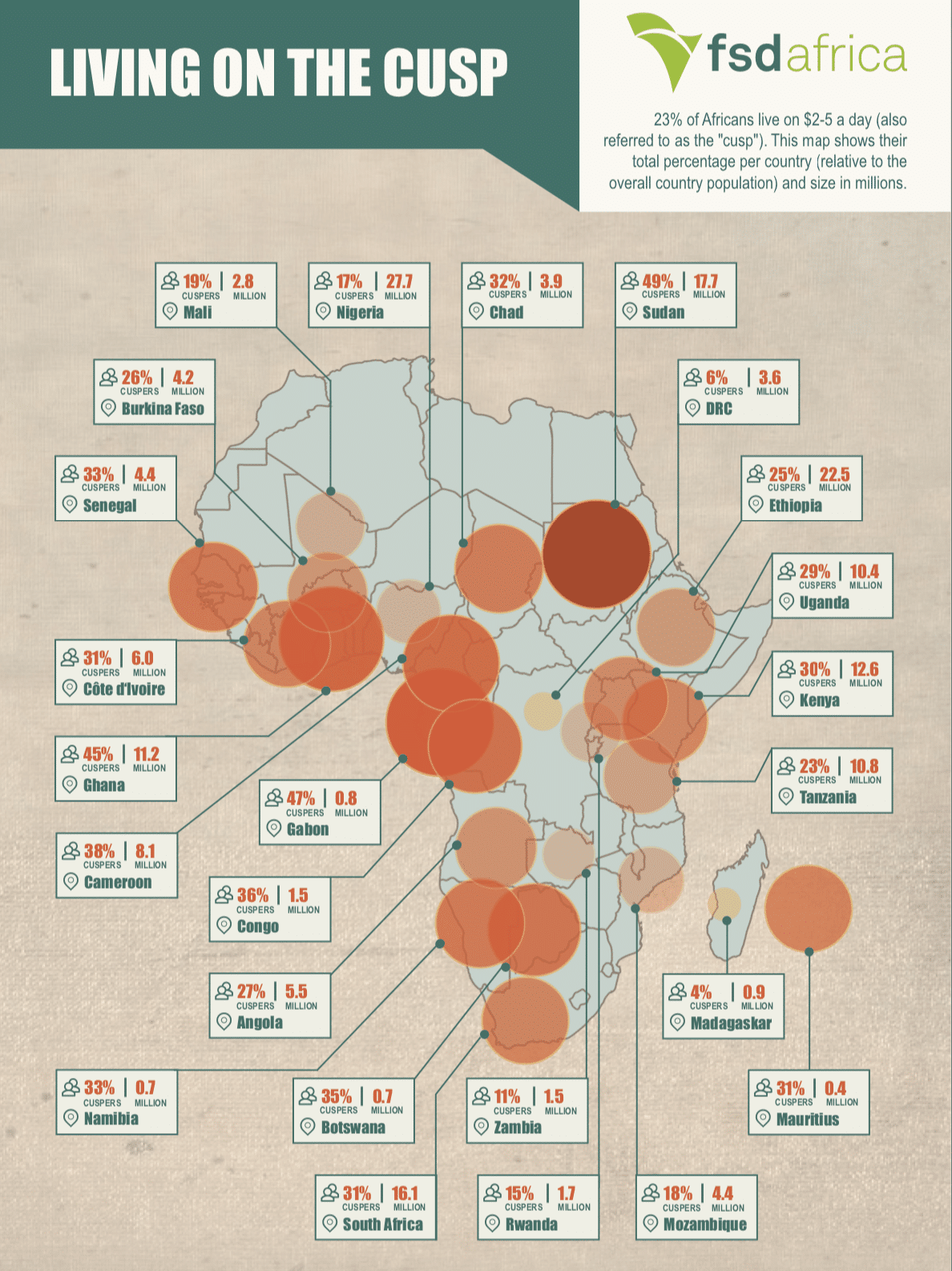
African economies are currently undergoing dramatic changes, including a changing consumer base.  Absolute poverty is reducing as a new class of consumer—the cusp group—emerges.  This group (we call “cuspers”), which now accounts for 23% of sub-Saharan Africa’s population, covers a segment of active earners getting by on $2-$5 per day and straddling the formal and informal worlds.  For this group, healthy credit markets could expand opportunity and enable upward mobility, helping to build a true middle class.  But, for this to happen, credit needs to expand and to do so in healthy ways.

In the Credit on the Cusp project, we look at the experience of cusp group borrowers and the lenders who serve them in three distinctive markets—South Africa, Ghana, and Kenya—to better understand what healthy credit market development would mean for this group.  We explore some ways donors and policymakers can help build credit markets thaard mobility for Africa’s cuspers.

Risk, remittances and integrity programme

The five-year RRI programme is a partnership between FSD Africa and Cenfri. Its aim is to improve welfare and boost investment growth in sub-Saharan Africa. To achieve this, it works to strengthen the integrity and risk management role of the financial sector and to facilitate remittance flows within and into the continent

Savings groups national stakeholder meeting

FSD Africa and the SEEP Network convened a stakeholder meeting in Benin in February 2017 to explore the role of savings groups in contributing to broader development goals and activities in the country.

Skills development in financial institutions in sub-Saharan Africa

Skills shortages among financial institutions (FIs) in Africa have long been recognized as an important- and perhaps the most important- constraint to their growth. In late 2012, the Consultative Group to Assist the Poor (CGAP) conducted a global on-line survey which aimed to better understand the dynamics within the market for skills development and other services; and to develop guidance for funders to support market development.

Subsequently, FSD Africa and CGAP sought to better understand the demand for and supply of capacity building services for financial inclusion in Sub Saharan Africa (SSA) by digging deeper into available data from the 2012 CGAP global research.  The aim was to explore differences in responses by service provider type and clusters of countries/sub-regions.

The key highlights from the SSA analysis include: FIs acknowledge that the most significant short-term challenge they face is the lack of capacity to run their institutions professionally and regard risk management, strategic plnning and mid-level and people management skills as most needed; although FIS are aware of the availability of the services they need in the marketplace, they do not always regard these to be of high quality.  Lastly, capacity building providers face the challenge of finding, training and maintaining qualified staff for the provision of high-quality services

Is cash no longer king? A surge in the use of online remittance services

Remittances are a pivotal, though often unseen, driver of economic growth across Africa, in particular having a positive pro-poor effect on health, education and human capital development. The continent’s remittance economy has grown quietly and organically, taking up an essential role not just as a safety net, but also as a catalyst for entrepreneurship. Why is this so important? Because it changes how we should think about remittances: these flows are international development finance by another name, with the potential to be highly targeted, efficient and effective.

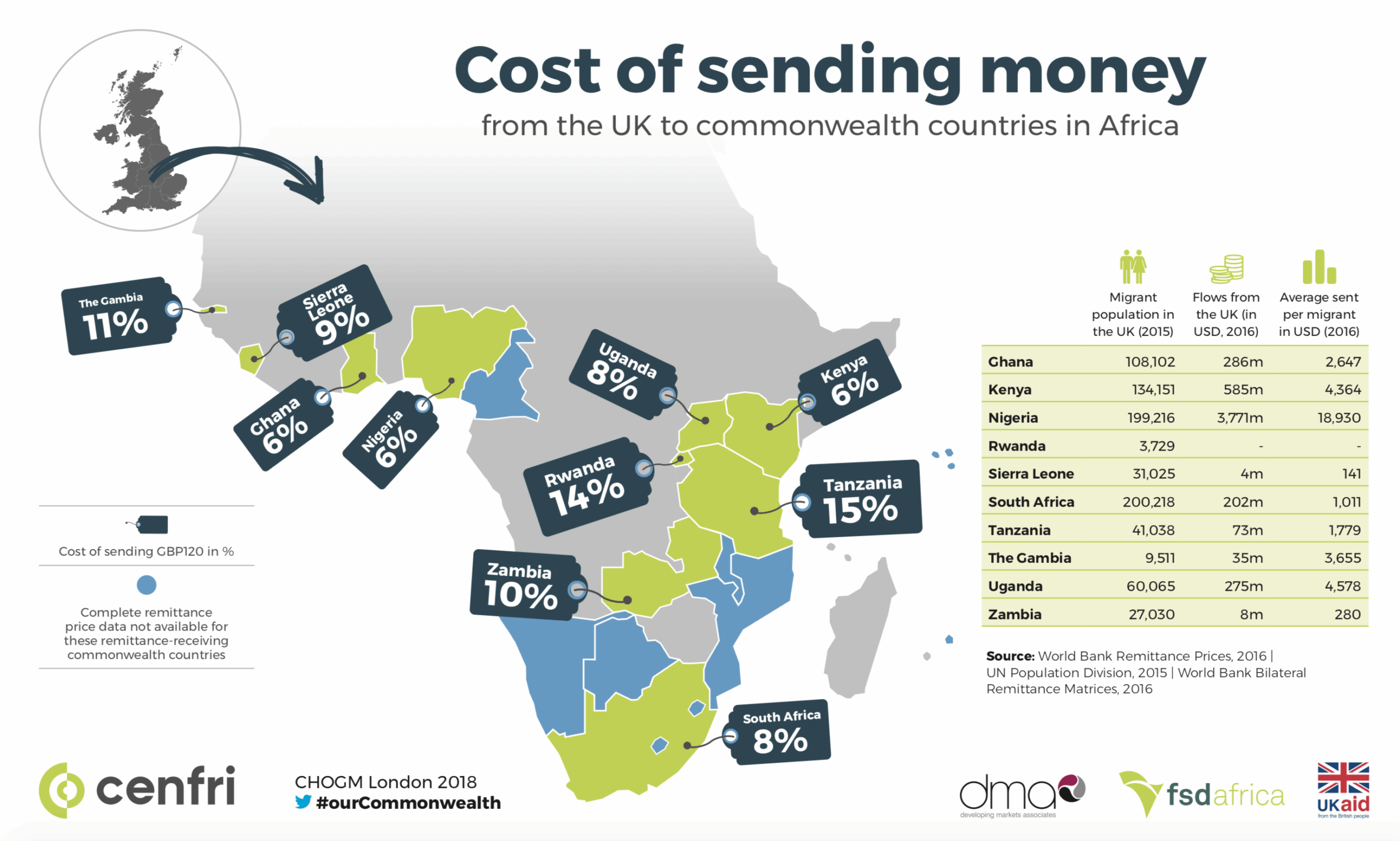
Remittances are an efficient, impactful and resilient form of development capital. FSD Africa has supported research by Cenfri which shows that the value of remittances in sub-Saharan Africa (SSA) is almost equal to that of “traditional” foreign capital flows such as overseas development assistance (ODA) and foreign direct investment (FDI). And their impact is potentially greater – especially in areas like health and education. In 2015, the region received USD39 billion in FDI and USD37.1 billion in ODA, compared to USD34.6 billion in remittances. However, between 2012 and 2015, formal flows of remittances grew at a higher growth rate than both FDI and ODA. If we isolate the UK as a source of capital, between 2015 and 2016 remittance flows actually overtook the value of ODA and FDI combined. Cenfri’s most recent case study, Remittances in Uganda, tells us that remittances from the UK to Uganda amounted to USD275 million annually – more than double the amount of foreign aid from the UK.

Yet the cost to send money home remains high. The average cost of remittances to SSA is over 9% of the value of the transaction, compared to a global average of 7% (we dig deeper into this in our infographic on the cost of remitting money from the UK). We want to bring these costs down. Signatories to the UN’s Sustainable Development Goals have pledged to reduce the average transaction costs of remittances to less than 3% of the amount transferred by 2030, with no remittance corridor costing more than 5%.

Our new research, Moving Money and Mindsets, shows an exciting new trend towards transferring money online. In 2016, 90% of remittances from the UK were being paid in cash at an agent. Fast forward two years, and we found that roughly half of focus group members now use online services – a significant and rapid switch in behaviour. Online remittances providers – like WorldRemit, Wave and TransferWise – not only provide transparency, security and convenience but are also significantly cheaper. It costs almost £16 to send £120 from the UK to Ethiopia in cash using an agent. The same amount costs only £6 to send online. Switching online clearly makes economic sense, so why stick to cash?

Some remittance markets are simply “stickier” than others. In countries with underdeveloped payment systems – like Zimbabwe, Sierra Leone and the DRC – cash is still king. For example, in the DRC, less than 10% of people have a bank account, and mobile money is virtually non-existent. Other barriers to switching to online services include the registration process, perceived security issues and technological barriers for older people. The solutions range from relatively easy quick fixes like simplifying the registration process and marketing online services to customers to longer-term interventions designed to develop digital payment infrastructures in Africa. Our Risk, Remittances and Integrity (RRI) Programme is working at the individual, regional and global levels to remove these barriers to switching to online, and to bring the transfer costs down. Cash may still be king in some countries in Africa, but cash is costly and with digital alternatives on the rise, its reign may be nearing its end.

Read FSD Africa’s new research, “Moving Money and Mindsets” here.