Country: Ghana

Financing the frontier: inclusive financial sector development in fragility-affected states in Africa

Poverty in sub-Saharan Africa (SSA) is reducing, but the concentration of extreme poverty in fragile states is likely to increase, according to a new report published today by the Financial Sector Deepening Africa in partnership with Mercy Corps. The report concludes that the donor community can crowd-in legitimate financial market actors and provide the flexibility needed to take risks, and allow development actors to pivot as the fragility-affected states in Africa (FASA) change and adjust.

SSA has one of the world’s highest refugee and internally displaced populations – over 19 million people in 2016 – and the numbers are rising due to new and ongoing crisis in several countries. According to the report, SSA has 483 million people living on less than US$1.25 per day, representing a poverty gap three times the level of South Asia. Poverty rates in fragile states are, on average, 20% higher than countries with comparable levels of economic development; the gap is widest for countries affected by repeated cycles of violence. Finance plays a crucial role in poverty and conflict cycles, as lack of equitable access to financial services can lead to underdevelopment and stagnation, exacerbating social and economic unrest.

As a group, fragile-affected countries lagged behind in reaching the Millennium Development Goals; nearly two-thirds failed to meet the goal of halving poverty in 2015. Today, the 50 countries and economies on OECD’s 2015 fragile states list – of which 30 are African – are home to 43% of the global population who live on less than US$1.25 per day and by 2030, this figure could reach 62%.

Commenting on the report, Joe Huxley, the Regional Strategies Co-ordinator at FSD Africa says: “Fragile economies require special attention if financial sector development outcomes are to be shared evenly throughout the continent. A vibrant financial sector provides room for facilitating employment creation, embarking on infrastructure projects, and opening-up new economic opportunities for entrepreneurs and small businesses. It is incumbent upon the private sector, governments and government agencies, and international development organisations to scale up efforts to build financial systems that are efficient, robust and inclusive in Africa.”

The report comes at a time when there is increasing recognition that inclusive financial market development in SSA faces new challenges, with levels of financial sector under-development in FASA distinctively lower than non-fragile counterparts. Examples of such challenges include: increasing degree of forced population movements, and recurrent humanitarian cycle of needs; weak and incentives for financial service providers; high prevalence of, and reliance on, informal financial mechanisms; wide-spread infrastructure deficits; and high levels of distortion from humanitarian aid and short-term investments from donors.

Thea Anderson, the Director, Financial Inclusion at Mercy Corps says: “A strong, transparent financial sector can contribute to economic stability, which can be both a driver and a result of overall stability. Financial inclusion can address income equality issues and is a core means to tackle vulnerability in FASA. It is critical to recognise that situations of fragility do not follow clean patterns, but rather often exist in ‘complex crisis’ situations for protracted periods of time. To address, we should prioritise market system solutions. While each FASA situation is unique and complex, using a market systems approach allows us to adjust tactics but adhere to several key principles: think long term, do not ignore the informal sector, ensure a positive business case, carefully sequence interventions, and utilise a diverse package of smart aid instruments.”

The report dubbed, “Financing the Frontier: Inclusive Financial Sector Development in Fragility-Affected States in Africa” provides justification for donors and development actors to invest in the foundations of a functional financial sector in FASA and the critical need for personal identification (ID) solutions and fit for purpose financial regulations. It also addresses the role the financial sector plays in resilience-building and fostering economic opportunity in FASA.

Financial sector development in FASA can: reduce transaction costs; build capital markets; encourage the development of entrepreneurship and business growth; provide options for mitigating risk and responding to shocks and stresses; and contribute to overall stability-building measures. FASA provides increased opportunity for payments and remittances infrastructure and diaspora investments as financial strategies to diversify risk central to both formal and informal financial sectors in FASA. The report highlights several promising trends in FASA including, finance for refugees and internally displaced populations, Islamic finance, inclusive insurance, and the increased use of liquidity facilities and increasing impact investing.

Five reasons why capital markets matter in Africa

The significance of developing domestic capital markets as a means of financing priority sectors and driving economic development is increasingly being acknowledged by policy makers in Africa.

For instance, the African Union (AU), Agenda 2063, prioritises the development of capital markets on the continent to strengthen domestic resource mobilisation and double its contribution to development financing. Similar support is found in several national visions including Nigeria (FSS2020), Zambia (Vision 2030), Rwanda (Vision 2020), Uganda (Vision 2040) and Kenya (Vision 2030). About US$1 trillion in assets are currently held by pension, insurance and collective investment vehicles across sub-Saharan Africa. These funds have a serious problem finding enough investments that meet their risk and return requirements – there just isn’t enough “product” for them.  It means that there are projects today – e.g. in infrastructure – that are not getting financed. But this also has implications for the long-term ability of pension funds to produce adequate incomes for pensioners.

While central to facilitating SSA economic development, there has been little focus on understanding precisely why capital markets matter in Africa.

So why does Africa need capital markets? This article identifies five reason reasons:

  1. Providing long-term financing for priority sectors

Africa faces huge long-term financing needs for the real and social sectors.  FSD Africa (FSDA) estimates the funding gap for SMEs, infrastructure, housingness at over US$300 billion per year. The World Bank estimates that Africa’s infrastructure deficit reduces per capita GDP growth by 2 percentage points each year, delaying poverty reduction efforts. Equally, the Centre for Affordable Housing in Africa, estimates a housing deficit of at least 25 million units in Nigeria, Kenya, Angola, Ethiopia, Cameroon and Cote d’Ivoire. Local currency capital markets can contribute to narrowing the financing gap across these sectors. Capital markets provide long-term funds to growing businesses, infrastructure and housing. Capital markets can also support the financing of social sectors, including health and education.

  1. Complementing reductions in concessional funding

About half of the countries in sub-Sahara Africa are classified as middle income according to the World Bank. In the last decade, 10 countries in sub-Saharan Africa including Kenya, Nigeria, Ghana and Zambia, have joined this middle-income rank. This implies that these countries will gradually be weaned off the World Bank Group’s concessional lending window, International Development Association (IDA). In addition, they can expect to receive less concessional funding from bilateral donors. This implies that many of these countries will need to access commercial funding sources. The Eurobond market, one of such sources, exposes countries to significant foreign currency risk, because these bonds are denominated in hard currencies, leading to higher chances of defaulting on this debt. Local currency capital markets can ideally complement external funding to meet developmental challenges.

  1. Financing global challenges

According to the African Development Bank (AfDB), the share of Africans living in urban areas is set to rise from 36% in 2010 to 50% by 2030. Urbanisation at this rate can cause significant stress to infrastructure, social services and proliferation of slums. According to the United Nations Environmental Program (UNEP), Africa is projected to bear the greatest impact of climate change with the costs of adaption being estimated between 5-10% of GDP. Capital markets can contribute to financing of climate change investments through green bonds. Capital markets can also support urban development by financing urban infrastructure and housing projects. Capital markets instruments including Real Estate Investment Trusts (REITS), incorporating so-called Social REITS, can support affordable housing finance.

  1. Managing foreign currency and re-financing risks

The income streams associated with key infrastructure and housing investments are often denominated in local currency. By funding these investments in long-term local currency instruments, governments and the private sector avoid foreign exchange and refinancing risks. The Asian financial crisis in the 1990s and the crisis in Latin America in the 1980s powerfully demonstrated the importance of developing local currency markets. In Asia, overexposure to foreign currency loans led to economic collapse in several countries. On the other hand, refinancing risk arises where short-term debt is used to fund long-term projects. Failure to roll over this debt in the short term can lead to high financing costs and potentially defaults. Numerous examples exist where this has resulted in collapsed companies and job losses.

  1. Diversifying the financial sector

The financial sector in Africa is relatively small and bank-dominated. There have been significant advances in the banking sector over the last decade with increasing access to previously excluded populations, especially using mobile technology. However, the banking sector remains characterised by high interest rate margins and high returns on equity and assets. This implies that the sector is not playing its intermediation role effectively. By developing capital markets, countries can facilitate the diversification of the financial sector, providing a useful complement to the banking sector (at times competing with the banking sector, at other times encouraging it, e.g. through risk sharing instruments, to play a bigger role in new areas) and providing the public and private sectors access to long-term financing which is so hard to come by in SSA.  Capital markets can also help create new kinds of institutions through equity investment, tus broadening the sources of supply of finance.

As a strategic response, FSDA aims to transform capital markets in Africa into a credible source of funding for the real and social sectors. The priorities over the next five years include the bond markets (both government and non-government), alternative finance (including fintech and crowd funding, REITs and Islamic Finance), and equity (public and private) market development. Support for non-government bonds will focus on green bonds and issues in both the real and social sectors.

FSDA will leverage technical assistance interventions on the regulatory front with transactions support, aimed at developing a pipeline of potential issuers, and catalytic investments through development capital (DevCap). FSDA also aims to build the information base around long term finance – databases currently are scarce and incomplete – and will work closely with institutional investors to build their capacity to invest in the newer asset classes. FSDA will actively forge perships to implement its long-term finance agenda.,

Credit on the cusp

Building healthy credit markets in Africa by 2026

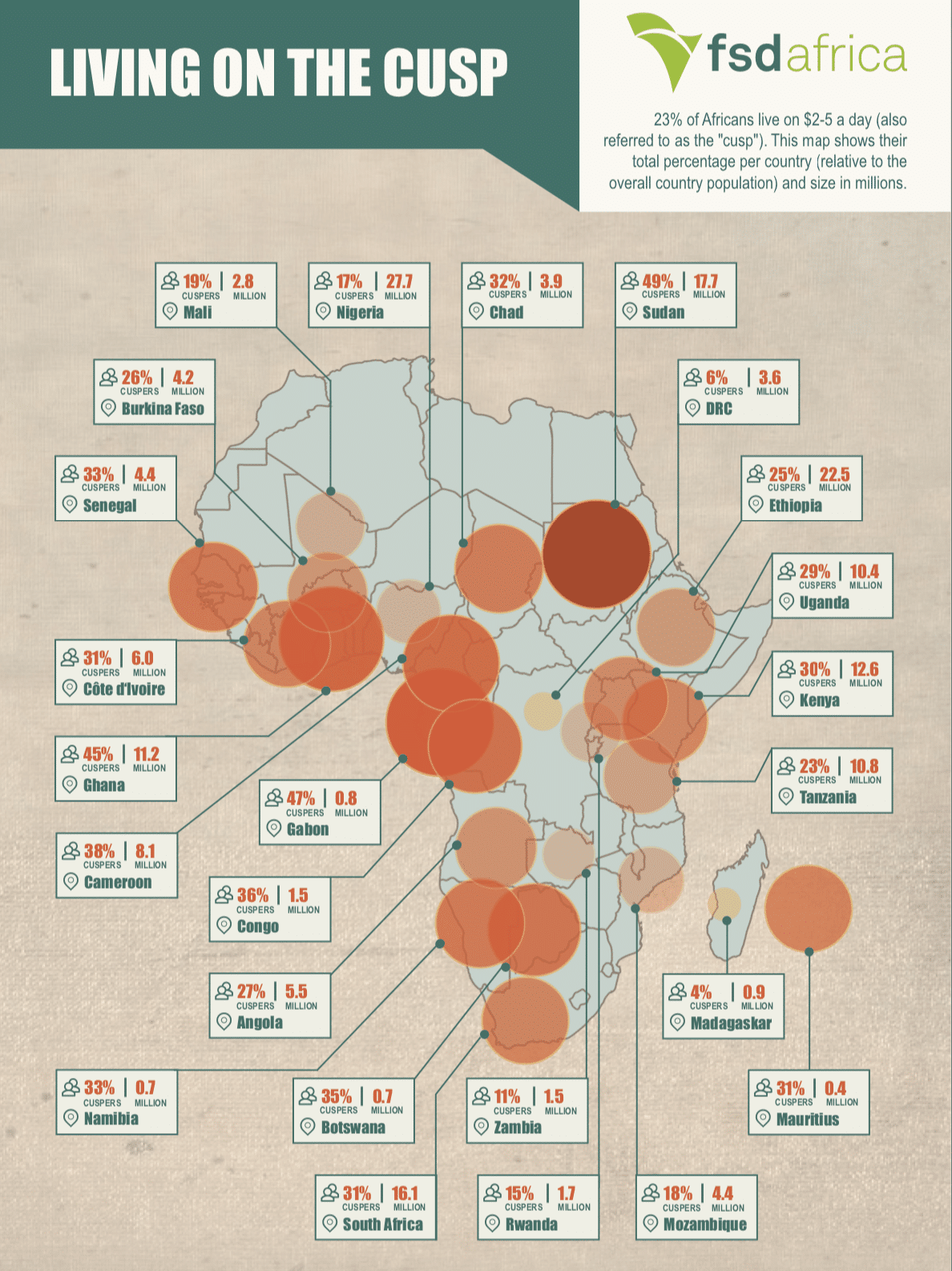
African economies are currently undergoing dramatic changes, including a changing consumer base.  Absolute poverty is reducing as a new class of consumer—the cusp group—emerges.  This group (we call “cuspers”), which now accounts for 23% of sub-Saharan Africa’s population, covers a segment of active earners getting by on $2-$5 per day and straddling the formal and informal worlds.  For this group, healthy credit markets could expand opportunity and enable upward mobility, helping to build a true middle class.  But, for this to happen, credit needs to expand and to do so in healthy ways.

In the Credit on the Cusp project, we look at the experience of cusp group borrowers and the lenders who serve them in three distinctive markets—South Africa, Ghana, and Kenya—to better understand what healthy credit market development would mean for this group.  We explore some ways donors and policymakers can help build credit marable upward mobility for Africa’s cuspers

Next thought Monday: beyond ‘Africa rising’ – the emergence of the not-quite middle class

The past five years or so have seen a number of exuberant studies and predictions that Africa’s rapid growth was creating a new middle class. This new group of consumers, it was argued, would become an engine of domestic demand, reducing reliance on exports and sustaining economic growth in the same way as they have in China. There were even predictions that this new middle class would transform governance and politics. This was the hopeful and optimistic story of “Africa Rising.”

Click here to read more

Harbingers of doom? bank failures in Africa – how to interpret these

Yesterday, Zambia’s central bank announced it had taken over a commercial bank, Intermarket, after the latter failed to come up with the capital it needed to satisfy new minimum capital requirements. Three weeks ago, a Mozambican bank – Nosso Banco – had its licence cancelled, less than two months after another Mozambican bank, Moza Banco, was placed under emergency administration.

At the end of October, the Bank of Tanzania stepped in to replace the management at Twiga Bancorp, a government-owned financial institution which was reported to have negative capital of TSh21 billion.  A week before that, just over the border in Uganda, Crane Bank, with its estimated 500,000 customers, was taken over by the central bank, having become “seriously undercapitalised”. In DR Congo, the long-running saga of BIAC, the country’s third largest bank, continued in 2016, forced to limit cash withdrawals after the termination of a credit line from the central bank. And in Kenya, Chase Bank collapsed in April, bars after the failure of Imperial.

How are we to interpret this? It seems that 2016 is the year in which latent fragility in Africa’s banking sectors is being laid bare.  After years in which observers have favourably contrasted the relative stability of African banking with the financial sector chaos in Europe and the US, it seems that three critical perils – mismanagement, political interference and economic woes – are conspiring to transform the landscape of African banking into a decidedly treacherous place for depositors and investors.

We have had remarkably few bank failures in Africa in recent years and yet this sudden uptick in stories like Crane and Chase, against a backdrop of economic challenges in many places, raises the question as to whether there is worse to come.

Mismanagement and/or political interference have been at the root of most bank collapses over the past few decades. Martin Brownbridge’s grimly fascinating analysi”https://fsdafrica.org/knowledge-hub/blog/harbingers-of-doom-bank-failures-in-africa-how-to-interpret-these/#_ftn1″ name=”_ftnref1″>[1] on this subject from 1998 concluded that “moral hazard, with the adoption of high-risk lending strategies, in some cases involving insider lending” was behind most of the bank collapses in the 1990s. This certainly resonates today. Catastrophic lapses in governance rather than economic malaise are alleged to be behind the recent Kenyan bank failures (although their shareholders and directors vigorously refute this) – but how else can you explain why a small number of banks fail when the sector as a whole has been returning well over 20% on its equity for the past several years?

There are some excellent programmes like “http://www.centerforfinancialinclusion.org/programs-a-projects/abf” target=”_blank” rel=”noopener”>Accions’s Africa Board Fellowship Program, which aims to strengthen capacity at financial institutions because their promoters understand that weak governance undermines trust in the financial system and is therefore very bad for financial inclusion. But it is one thing to know what you’re supposed to do as a bank board director – quite another to actually do it.

Each bank failure seems to have its own special story – and we derive comfort from this. It is somehow reassuring to think that that might be the case because the prospect of a system-wide failure is so awful.

And each country context has particular features that impinge on the stability of the financial system. There are deep concerns in Kenya, for example, that the recent imposition of interest rate caps is going to result in a very messy period of bank failures and/or consolidation.

But are there common patterns that we should be taking note of?  Is there a system-wide issue that we should be facing up to?

Well, one pattern might be positive – that central banks are intervening more, and more quickly, to weed out the miscreants, less cowed by the politicians than they might have been in the past and more concerned to protect their well-earned professional reputations. Another is that central banks are finally implementing the increases in minimum capital requirements which many have been talking about for years with the inevitable intended consequence that some banks will be forced to get out of the market.

These might be two good reasons why we are seeing more collapses. You could say that’s excellent news for the future of African banking. But perhaps only to a point. There is still the risk that the cumulative effect of bank failures as a result of zealous supervisory action causes a loss of faith in the entire system resulting in mass panic and the withdrawal of deposits and credit lines.

Also, the inevitable result of this would be fewer, bigger banks which may have negative consequences for competition and access – altht worth pointing out that Tanzania, which has 55 commercial banks, still only manages to bank around 12% of its adult population (FinScope).

The more concerning issue is the impact of underlying economic weakness. Leaving aside the paradox that some of these bank failures are taking place in economies that are growing quite fast (Kenya and Tanzania forecasting 6-7% GDP growth), lower commodity prices and their pervasive impact across African economies are going to make life much tougher for banks – especially if they are poorly managed and have political skeletons in their cupboards.

One problem we have, especially when economic conditions are changing fast and for the worse (as in Mozambique), is that data is often out of date and is not sufficiently disaggregated. So, when we look at Africa as a whole, or even the banking system of one country as a whole, the averages we tend to look at create a blithely benign picture which masks dramatic variations.

So, non-performing loans (NPLs) across Africa up to014 were a little over 5% but NPLs in Ghana were more like 11-12%. NPLs in Tanzania are currently a little over 8%, yet Twiga Bancorp’s NPL’s were – unbelievably – at 34% in early 2015, according to media reports.

We think the African banking sector is in for a rocky ride in 2017 and 2018 and, in the short term, this is not good news for the real economy. However, one industry that is set to grow, surely, is central banking supervision.

“https://fsdafrica.org/knowledge-hub/blog/harbingers-of-doom-bank-failures-in-africa-how-to-interpret-these/#_ftnref1” name=”_ftn1″>[1] Brownbridge, M (1998): “Financial distress in local banks in Kenya, Nigeria, Uganda and Zambia: Causes and implications for regulatory policy” Development Policy Review, vol. 16, no.

FSDA’s credit market development programme: the programme in brief

FSD Africa launched a new Credit Market Development Programme (CMDP) in July 2016. The Programme, which will run for three years, aims to support the development of credit markets across sub-Saharan Africa that are efficient, inclusive and maintain high standards of market conduct in order to expand quality access to retail and SME consumers. The development of effective credit markets will, in turn, contribute to financial sector development, economic growth and job creation. The rate of credit market growth depends on a number of factors. At a country level, credit markets are often undermined by weak regulatory frameworks, low levels of enforcement and insufficient market infrastructure. Such weaknesses breed predatory lending practices and increasing levels of debt stress which, if left unattended, result in increased risk to consumers. In creating an effective legal and institutional framework that supports robust market growth, it is necessary to strike a realistic balance between increased and more inclusive credit supply on the one hand and effective oversight over market conduct and consumer protection on the other.

The growth of micro-insurance: expanding financial inclusion

Access to insurance across sub-Saharan Africa (SSA) is still very low and estimated to cover only around 5.4% of the population (approx. 61.9m people)[1]. Most of this coverage is represented by life insurance products, the penetration of which still pales in comparison to most developed markets. In these markets, insurance products are part of the financial landscape and are more of an expectation rather than the exception. However, attitudes of insurers in SSA are changing. Financial Sector Deepening Africa’s (FSDA) work with the International Labour Organisation (ILO) has shown that insurers across the continent are looking to serve the market on a larger scale and through new channels.

Financial Inclusion has come a long way. Not long ago, the widespread definition of what it means to be “included” would only focus on access to a bank account. Thankfully, that notion has changed. A broader definition of the term has led to the development of many more services and ways to help lift the poor out of poverty – mobile money being the most prominent example.

Over the years, donor organisations (and market players) have understood that bank accounts are not enough to replace the abundance of products currently being used by people at the bottom of the pyramid. An in-depth look at the financial choices made by Kenyans in 2014 showed that the average household uses 14 different financial products.[2] Basically, the majority of people who have informal jobs are constantly juggling financial products, just to get by. About half of the respondents surveyed had an insurance product (directly or through welfare groups). However, effective use of formal insurance was low.

Improving and expanding insurance products for the poor

FSDA is in partnership with the ILO to expand microinsurance penetration in SSA thus helping poor people protect themselves against economic shocks. The FSDA funded project is looking to develop and grow new and existing microinsurance products across SSA[3], focused on the needs of the customer at or near the bottom of the pyramid. Together with the ILO’s Impact Insurance Facility, FSDA will work with five insurers and/or distributors in four countries – Kenya, Nigeria, Cote d’Ivoire and Ethiopia. The project will provide an inclusive financial service to more than one million low income people and micro, small and medium-sized enterprises (MSMEs) who will gain access to insurance products that protect them from life’s surprises.

Creating relevant microinsurance products

Most of the continent’s large insurers are bureaucratic and focus on standard general and life insurance products. Not only are these products unaffordable to the bottom of the pyramid, but most people do not qualify for the products as they usually require formal employment. In a context where informal employment is estimated to be between 60% and 80% across Sub-Saharan Africa, this excludes a large part of the population.

Change Management

Insurance organisations need to change people, systems and processes of how they approach the SSA market. Ultimately, there is work to be done to help move these insurance companies & distributors from providing an exclusive product to becoming an inclusive provider. FSDA’s project will involve supporting consultants to work within the selected insurance institutions for three years to help them manage the change from within. These consultants will work to deliver and develop services that are designed to help insurers expand their reach and become both profitable and highly scalable.

Partner Selection

Insurance is an important part of financial inclusion as it helps people to prosper and mitigate risk necessary to grow productive businesses. To ensure that capable and willing partners were found to drive this market-wide change of the insurance market, FSDA opened applications to insurance companies across the continent who are looking to change their target market to include the financially underserved. The application process was open from December 2015 to mid-January 2016 and attracted over 32 proposals from East, West, and Southern Africa. The number and quality of these applications show that the Sub-Saharan insurance industry is ready for a paradigm shift in their approach to microinsurance.

Mobile channels are boosting product access

Majority of applicants for the funding wanted to build on the rapidly growing mobile channel in all of their respective markets. The increasing presence and growth of the mobile channel has helped to boost inclusion of access to financial services.

Insurers are recognising the different needs of their markets. However, regional differences remain and reflect the level of development of the existing insurance market. For example, many proposals from West Africa, a much more nascent insurance market, focused on providing the simpler products, such as health or life insurance. By contrast, in East Africa, insurance was focused on complex products, such as weather-based index insurance or insurance for small and medium enterprises.

The insurance space in Africa is rapidly evolving and FSDA’s role will be to guide motivated and committed insurers to make the changes necessary to grow their footprint in the underserved market.

[1] The Landscape of Microinsurance Africa 2015 Preliminary Briefing Note by Microinsurance Network.

[2] Kenya Financial Diaries; August 2014

[3] Kenya Financial Diaries; August 2014

Measuring financial market facilitation: why the theory of change is king

This is the second of a four-part serialisation of the full Impact Oriented Measurement (IOM) guidance paper.

In the first serialisation, the principle objectives of IOM and the background to its development was provided. The first, second and third chapters were also discussed.

This second serialisation (Chapter 4 of the full IOM guidance paper) draws attention to the Theory of Change (ToC), a critical tool in the IOM system.

In particular, this Chapter:

  • Discusses the definitions of, purposes of and relationships between ToCs, results chains and logframes. It clearly explains what each of these tools are, what they are for and how they can be best developed for market facilitation programmes. It also demonstrates how project-level results chains should ‘nest’ within programme-level ToCs. In doing so, this Chapter helps to de-mystify the application of these tools within a programme’s overall approach to IOM.
  • Discusses the identification of impact measurement questions. The Chapter shows that ToCs and results chains help to identify impact measurement questions. It states that: “taking time to think carefully about impact measurement questions…will help focus both measurement and research activities.” This begins the process of monitoring through indicator selection and data collection.
  • Introduces ‘bottom-up’ and ‘top-down’ measurement. Readers learn that ‘bottom-up’ measurement involves the monitoring of the impact of individual interventions, while ‘top -down’ measurement involves the monitoring of financial market performance and socio-economic landscape (including poverty levels) as a whole. By triangulating evidence from the two, it is possible to more clearly discern/attribute the combined impact of a market facilitator’s interventions.

In the next installment – the third of the four-part serialisation – IOM will explore how to measure changes (including systemic changes at the market-level) resulting from FSD interventions and how to determine the causes of such changes.

Impact orientated measurement: monitoring and results measurement for financial market facilitation

In July 2014, FSD Africa began an FSD network-wide consultative process to improve monitoring and results measurement (MRM) for financial market facilitation.

Its specific objectives were two-fold: a) to strengthen MRM processes within individual FSDs at the project and programme level, and b) to develop a more consistent approach to MRM across the FSD network.

Through their participation and with the support of specialists from Oxford Policy Management (OPM) and the Consultative Group to Assist the Poor (CGAP), DFID and the Donor Committee for Enterprise Development (DCED), FSDs explored key MRM issues together. Topics included, for example:

  • Developing a common terminology for MRM work to avoid confusion within an FSD and with key partners (especially donors) and achieve consensus more quickly
  • Consolidating a rich, sometime complex portfolio of FSD project work into a single MRM framework that is coherent and measurable
  • Determining the core components (measurement tools, processes, indicators and management) of an MRM system to enable an FSD to quickly develop an approach that is well-understood, practical and which provides evidence in a timely, useful manner
  • Better defining and measuring change in financial market systems (that is both expected and unexpected) to help prove and improve an FSD’s market facilitation approach
  • Determining an FSD network impact research agenda to create a better understanding of the causal relationships between certain kinds of financial sector interventions and the impact they are intended to generate

The result of this extensive consultation is the Impact Oriented Measurement framework, or IOM.

IOM is a comprehensive resource that helps FSDs, or FSD-like organisations, manage the challenge of measuring their contribution to changes in the market systems they seek to influence.  IOM offers guidance, not a prescription.

There is a high degree of consensus built-in to the model, which is informed by practical insights derived from FSD practice over a decade or more, but also OPM, CGAP, DFID and DCED.