Author: Kihingu Inc

Announcing a Just Transition Finance Challenge

Financing a fair and inclusive transition to Net Zero

What is the Just Transition Finance Challenge?

The Just Transition Finance Challenge is a flagship initiative to mobilise more public and private capital into investments that support a Just Transition to Net Zero in the UK and other developed and emerging markets.

Launched by the Impact Investing Institute, with the support of the City of London Corporation, it brings together leading global financial institutions with over £3.6tn of assets and assets under management, including public and private asset owners, asset managers, development finance institutions and advisors, who are committed to financing a Just Transition.

This session presented a new coalition of key investors committed to mobilising capital towards impact investing and ensuring that the investment for a transition to Net Zero is inclusive and socially beneficial.

Moderated by Laurie Spengler, CEO of Courageous Capital Advisors and Senior Advisor for G7 Impact Taskforce, the panel consisted of Sharon Johnson, Chief Operating Officer, AgilityEco; Maria Nazarova-Doyle, Head of Pensions Investments and Responsible Investment, Scottish Widows; and Anne-Marie Chidzero, Chief Investment Officer, FSD Africa Investments.


Innovative finance is essential to tackle barriers to investment in Africa’s climate finance needs – at an average investment of USD 250 billion annually from 2020 to 2030

11 August 2022: The African continent presents a massive investment opportunity for investors to advance the deployment of climate solutions in the coming decade according to a new report Climate Finance Innovation for Africa. However, this will require innovation in financing structures and the strategic deployment of public capital to ‘crowd-in’ private investment at levels not yet seen.

Current levels of climate finance in Africa fall far short of needs. Africa’s USD 2.5 trillion of climate finance needed between 2020 and 2030 requires, on average, USD 250 billion each year. Total annual climate finance flows in Africa for 2020, domestic and international, were only USD 30 billion (CPI forthcoming), about 12% of the amount needed.

Barriers related to shallow financial market depth, governance, project-specific characteristics, and enabling skills and infrastructure have stifled private investment in African climate solutions to date.

To overcome these challenges will require innovation in financing structures. But there is no one-size fits all. Public and private investors must tailor their financial instruments and strategies depending on the acute or chronic nature of the barriers identified.

Recommended actions for increasing the deployment of innovative finance include: Identifying and understand barriers constraining finance by sector and geography, matching instruments with barriers, matching instruments with project and technology lifecycles, enhancing engagement and co-financing with local stakeholders, and supporting innovation by establishing conducive policy and regulatory frameworks.

This work provides a framework for how these instruments and strategies can be efficiently deployed to overcome barriers to finance and capitalise climate solutions in Africa.

Read full report here.

Building capacity for a more inclusive digital economy

The world has come a long way since the invention of computers in the 20th century. Digital triage tools are assisting community health workers in reducing maternal mortality in rural Africa. Bitcoin is now legal tender in the Central African Republic. The hashtag #BringBackOurGirls brought global awareness to the plight of 276 schoolgirls abducted in Northern Nigeria and was even retweeted by the former first lady of the United States of America. And, at the click of a button, lunch is at your doorstep! The fourth industrial revolution, a phrase coined by Klaus Schwab, the founder and CEO of the World Economic Forum, signals just how massive the potential magnitude of the technological changes happening around us is.

Today, the application of digital technologies is having a significant impact on economies and on societies. In Africa, digitalised economies present new livelihood and welfare opportunities for low-income people across the continent. Online e-commerce platforms like Jumia have provided access to new markets for small retailers, while logistics and ride-hailing platforms like Sendy and Little Cab have enabled drivers and boda-boda riders to earn a liveable wage. Successful fintechs like MFS Africa and Chipper Cash are allowing more affordable and reliable access to remittances for low-income people across Africa, and insuretechs like PharmAccess are providing vulnerable people more affordable access to healthcare.

These opportunities, however, do not come without risks and access issues persist. The ‘digital divide’ refers to the gap between those who can access and benefit from the internet – and those who cannot. Despite the rapid expansion of broadband and mobile data coverage across the continent, many Africans remain excluded. Data is still very expensive and unaffordable for millions of low-income people and digital literacy remains low, particularly among women, older people and rural dwellers. The digital divide grows when we take relevance into consideration. Are digital tools accessible in local languages? Are solutions relevant and beneficial for the majority of Africans?  If governments and other market actors do not actively work towards closing digital divides, the inevitable continued growth of digitalised economies risks excluding millions of Africans.

In 2020, FSD Africa and the FSD Network partnered with Digital Frontiers Institute (DFI) to develop a course on inclusive digital economic development (iDED). This 4-week course brings together definitions, tools and terminologies from global thought leaders on the digital economy and provides learners with an inclusive perspective and the digital economy’s effects on low-income and vulnerable people. The offering provides the sector with a solid foundation for professionals working in the digital economy who are passionate about inclusive development.

This collaboration builds on our long-term partnership with DFI to build a new Digital Finance profession for Africa. FSD Africa is providing full scholarships for 40 excellent candidates from Ethiopia, Ghana, Nigeria, Somalia or Sudan who are interested in pursuing the course in October 2022.

There is no doubt that the digital transformation age is an exciting one, with opportunities beyond our imagination and value we are still learning how to measure. It is, however, important to remain grounded in the principles of equity and inclusion that govern how each of us meets our basic needs. We encourage professionals working in governments, development organizations and the private sector who are interested in building an inclusive digital economy to apply for a full iDED scholarship from FSD Africa here.

FSD Africa and CDG Capital support Africa’s first corporate clean mobility green bond worth $95m issued by Morocco’s National Railway Operator

This is Africa’s first corporate clean mobility bond worth 1 billion dirhams ($95m) launched by the Office National des Chemin de Fer (ONCF) to facilitate the refinancing of the operations of an electrified railway line aiming to achieve low carbon transportation in Morocco.

Casablanca, 28 July 2022: Africa’s first corporate clean mobility bond has today been launched by Morocco’s national railway operator (ONCF). ONCF was supported by CDG Capital in the strategic advice, structuring, placement, centralization, and coordination of the green certification work with its partners FSD Africa and CBI.

With this issuance, ONCF is targeting to raise approximately 1 billion dirhams ($100m) to support the Al Boraq project, which has led to considerable gains for the community in terms of connectivity, travel time and frequency, while reducing greenhouse gas emissions.

This high-speed line (Ligne à Grande Vitesse – LGV) project is part of a master plan to connect Tangier to Marrakech by 2030, advancing economic development by providing faster inter-urban passenger and freight lines with reduced carbon emissions. Through the LGV Journey time between Tangier and Kenitra has been reduced by 2 hours and 25 minutes and will result in a reduction of over 2.9 million tonnes of carbon equivalent over a 30-year timeframe.

Climate Finance is an important focus area for FSD Africa. This project presents an opportunity for FSD Africa to support the issuance of Africa’s first corporate clean mobility bond.
Mark Napier, CEO – FSD Africa

FSD Africa and Rabobank ACORN/Rabo Foundation to fund sustainable farming for African small-scale farmers with loans for carbon credits

FSD Africa will support Acorn projects in the initial scale phase that aims to benefit around 3,000-5,000 small-scale farmers whilst Acorn has the ambition to reach 1 million farmers all over the globe following the scale-up.

Nairobi – 27 July 2022: FSD Africa and Rabobank ACORN / Rabo Foundation today launched their collaboration in helping small-scale farmers with their transition to Agroforestry, a sustainable and climate resilient farming practice.

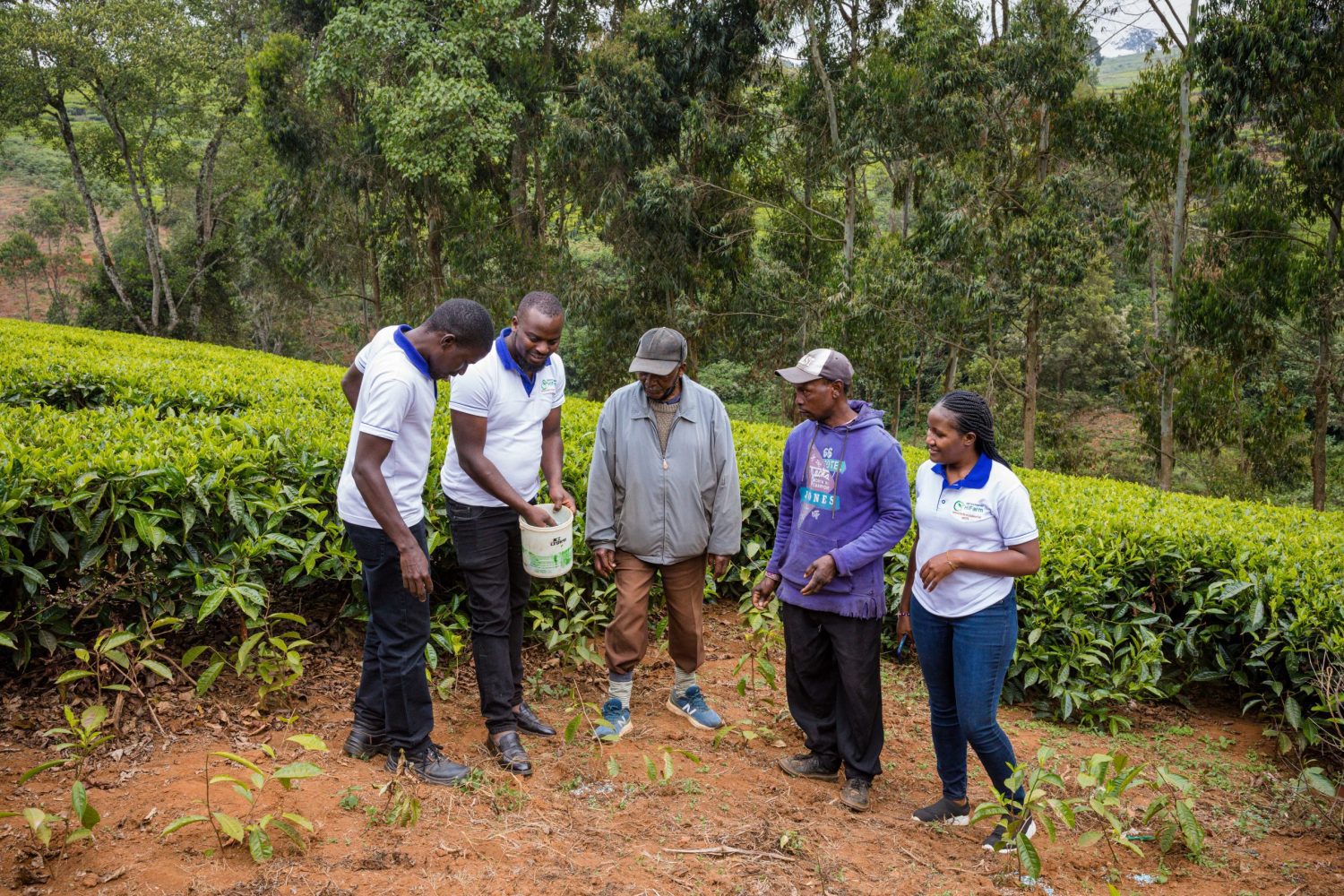
Acorn – Agroforestry Carbon removal units for the Organic Restoration of Nature – is a program being developed by Rabobank to unlock the international carbon market for smallholder farmers in the developing world. It aims to help farmers transition to agroforestry at scale and monetize the carbon stored in the trees planted through Acorn’s global transparent and technology-enabled marketplace for carbon sequestration. The collaboration will focus on kick-starting new small-scale farmers’ agroforestry projects in Kenya, Nigeria and Zambia.

FSD Africa together with Rabo Foundation will provide finance to the small-scale farmers to help them transition to sustainable agroforestry. The local implementation partners will collect the farmer data and onboard the farmers onto the Acorn platform. They will then be able to sell carbon removal units (CRU) to corporate off-takers through Acorn’s technology-enabled marketplace. The proceeds of the CRUs will be used to pay back the loan. For FSD Africa as the financier, testing this innovative finance structure will be an important outcome of this first scale phase.

We are proud to acknowledge that this program will contribute to 8 out of 17 UN SDGs, including those related to poverty reduction, food security, reduction of pollution, economic productivity, resilience, sustainability of forests and capital mobilization.
Mark Napier, CEO – FSD Africa

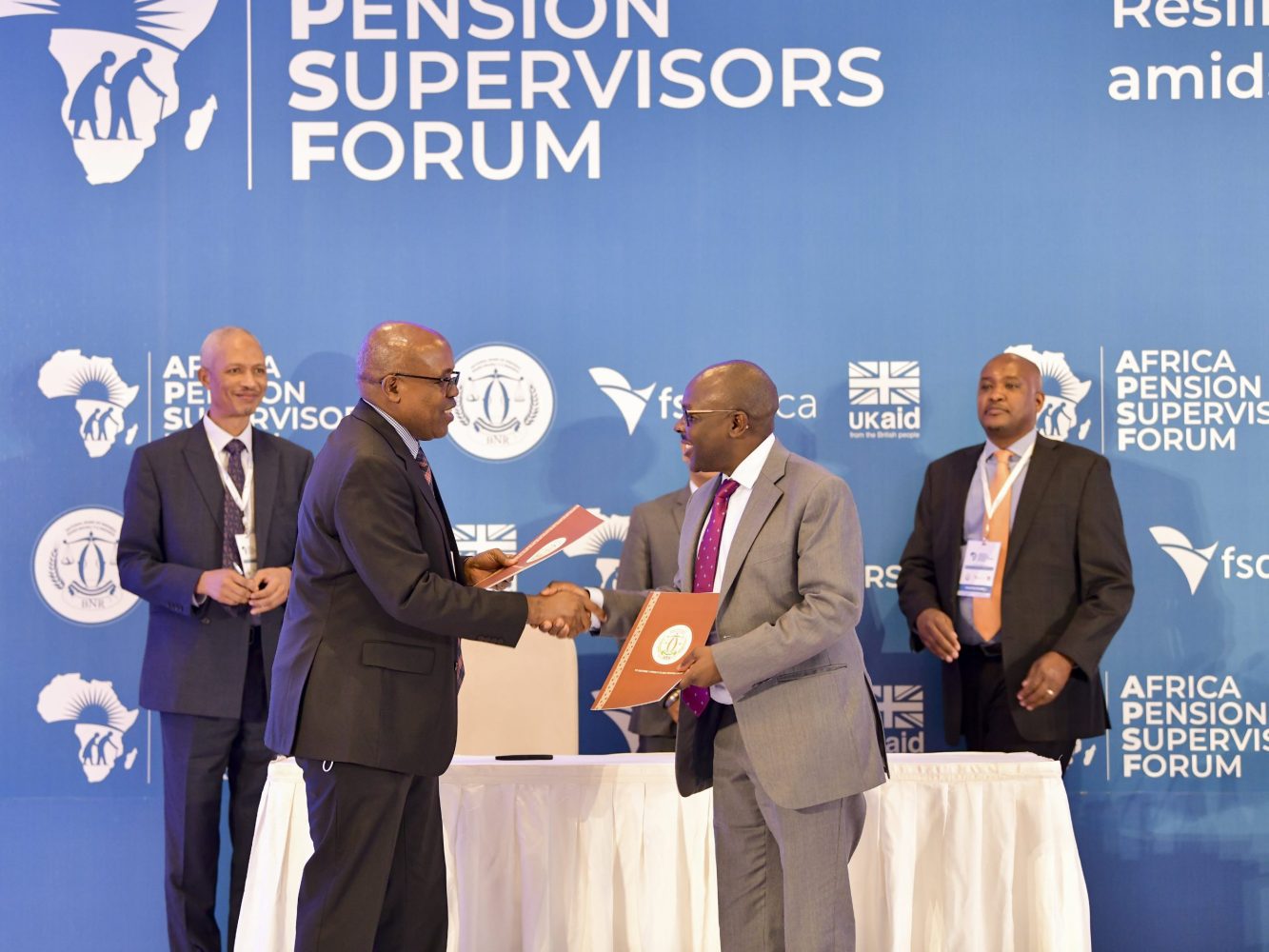
FSD Africa signs agreement with Africa Pensions Supervisors Forum at annual conference

Partnership to strengthen the continent’s pension sector, benefiting retirees and long-term savers.

Kigali, July 14 2022: The Africa Pensions Supervisors Forum (APSF) held its third annual forum in Kigali from July 14-15, 2022. The forum brought together pension supervisors from different African countries to deliver a harmonized approach for interventions and reforms in the pensions sector across the continent. The theme of the conference was “Resilience and sustainability of the pension sector amid the crisis- The case of covid 19 pandemic”.  Pension supervisors in Africa, relevant stakeholders, experts and partners in the pension industry shared experiences, discussed opportunities, challenges faced by the pension industry and new developments in the industry.

Through the network, countries will be better placed to tackle common problems and find solutions to challenges unique to Africa. The challenges include lower investment returns and Africa’s labour structure that comprises approximately 86% of labourers being in the informal sector and with limited access to the pension services.

By partnering with APSF we are jointly paving the way for a Harmonized approach towards interventions and reforms in the pensions sector. Our collaboration will forge solutions that speak to Africa’s unique pensions landscape.
Dr. Evans Osano, Director, Capital Markets – FSD Africa

FSD Africa invests $3.5M in Catalyst Fund to accelerate and scale pre-seed impact ventures in Africa

London 14 July 2022: Global inclusive tech accelerator Catalyst Fund, managed by BFA Global, announced today that FSD Africa has invested $3.5M to anchor the Fund’s presence in Africa and scale its work as the leading accelerator and pre-seed impact fund for emerging market entrepreneurs.

With FSD Africa’s backing, Catalyst Fund will invest and offer hands-on venture-building support to high-impact startups that improve the resilience of underserved and climate-vulnerable communities, to support 40 pre-seed impact ventures in Africa. The accelerator will also continue to build strong innovation ecosystems by activating investors, capacity-building networks, and corporate innovators to unlock capital, attract talent and share knowledge about

Our partnership with Catalyst Fund will spur innovation by investing in and supporting entrepreneurs while at the same time helping to influence and expand the pool of investment in this space.
Juliet Munro, Director, Digital Economy – FSD Africa

Pension savings a must for Africa’s retirees

Who will look after you when you’re retired? Will it be your children, as you did for your parents when they became old? Will they be able to afford to support you, while raising their own family?

A great tragedy we see too often is old-age poverty. Where, after a successful career and life, our elderly fall into poverty. This is mainly due to lack of retirement savings through formal pension schemes or other ways of saving for retirement, for needs such as food, shelter, and medication.

While you would expect that those most affected are in informal sectors, it is disturbing to note that even those in formal sectors where there are no government-driven retirement plans are also affected. Poor plans for old age are a result of retirement illiteracy, closed-mindedness towards retirement contributions and limited access to savings channels.

Between 2014 and 2019, investments in private equity accounted for less than one per cent of total pension assets for most countries in sub-Saharan Africa.

Effecting systemic change has become critical in ensuring that future generations do not suffer due to a lack of enough retirement cashflows to sustain their lives. This has a direct nexus with economic development, poverty reduction, improved livelihood, and increased resilience of individuals.

The pandemic caused a 6% fall in per capita incomes in 2020 – setting living standards back by a decade in a quarter of sub-Saharan Africa, (WB, Jan 2021). Gross Domestic Product (GDP) Losses were estimated at $146bn in 2020-2021, with an estimated 25 to 30 million jobs lost.

With this, the continent faces a financing gap for future development of $290 bn for 2020–2023. Private flows would barely cover half of the financing needs while other flows from various donors are thin. According to the International Labour Organisation, pension coverage remains low in Africa with only 9.6% active contributors from the working-age population (15-65 years).

Domestic resource mobilisation has received greater limelight during the Covid-19 period – in line with the Africa Union Agenda 2063, with pension sector development being recognised as key in filling this funding gap. Furthermore, through its asset allocation, pension funds can direct more resources to the private sector, boosting jobs and growth and finding its way to climate-friendly investments.

In 2019, FSD Africa formed the Africa Pension Supervisor’s Forum (APSF), which has a membership of 10 African regulators – Botswana, Egypt, Mauritius, Ghana, Kenya, Nigeria, Rwanda, South Africa, Uganda and Zambia – who combined are responsible for 86% of pension assets on the continent.

The APSF was formed to pave the way for a harmonised approach and collaboration towards interventions and reforms in the pensions sector across the continent. The first APSF Conference, themed Unlocking Africa’s Pension Potential, covered critical topics including new investment products, asset allocation policies, sustainable/climate investments, automation of pensions contributions, incentives for inclusive pensions and emerging trends in RegTech, fintech and SupTech.

Under the Africa Pensions Supervisor’s Programme, which resulted from the APSF, FSD Africa aims to carry out holistic interventions through the application of innovations and a joint approach to resolving common challenges in the region’s pensions sector. This will ultimately encourage long-term savings to not only meet the pension assets’ growth potential but also create facilitative policy, regulatory and industry environment to support appropriate deployment and investment of the pension assets. The initiative also aims to increase pension literacy and knowledge building on retirement products and investments.

To achieve the above targets, Africa Pensions Supervisor’s Programme is looking at ways to provide technical assistance to develop guidelines and regulations that would allow access to retirement savings for housing and mortgages. This will go a long way toward resolving the ongoing housing affordability crisis.

A revolution in the continent’s pensions sector is beckoning. It is envisaged that through this programme, longer-term financial sector and social and real economy impacts will be realised. By deploying capital resources drawn from the pensions sector, it will be possible to efficiently and effectively finance long-term inclusive economic growth. In addition, the programme will also create a sustainable future for pension contributors and increase access to basic services during retirement through cashflows from pension savings.

Catalytic patient capital provided by FSD Africa Investments for climate venture building

Persistent raises $10 Million Equity Round led by Kyuden International and FSD Africa to grow climate venture building in Africa

New York, Nairobi, Tokyo: 12 July 2022 – Today, Persistent Energy Capital LLC announced that it has raised USD 10M in equity in its Series C round.  The raise, which was achieved with the support of two lead institutional investors, Kyuden International Corporation and FSD Africa Investments, will enable Persistent to continue to grow its successful climate venture building business in Africa.

The equity raise took the form of Series C Preferred Units of ownership in Persistent, giving Series C investors a seat on the Board of Directors. The largest investor of this Series C round, Kyuden International Corporation (“Kyuden”), is the overseas business arm of the Japanese Kyushu Electric Power Group. Kyuden has energy investment activities and consulting services across the world and shares with Persistent a strong commitment to renewable energy and building sustainable communities. Investing in Persistent represents a strategic move for Kyuden to expand their overseas business with an established partner in Africa, where the demand for clean power and electric mobility is growing dramatically. Persistent will benefit from the expertise, know-how, and network accumulated from domestic and overseas energy businesses of Kyuden around the globe.

This successful fundraise was also achieved thanks to the catalytic patient capital provided by Financial Sector Deepening Africa Investments Ltd.

We are delighted to support Persistent as it expands its innovative climate venture building model. We look forward to working with the Persistent team to accelerate the investment needed by African entrepreneurs in the nascent and fast-growing climate sectors. The combination of Persistent’s capabilities and approach, together with FSDAi’s expertise, patient capital and focus on green finance represents a very strong proposition in areas where innovation and early-stage equity capital are highly needed.
Anne-Marie Chidzero, CIO – FSD Africa Investments

FSD Africa Investments joins 2X Collaborative

Membership to 2X Collaborative paves way for FSD Africa’s participation in the co-creation of the 2X Certification mechanism and enhances FSD Africa Investment’s co-investment, networking and partnership opportunities on gender lens investing

Nairobi: 5th July 2022: FSD Africa Investments (FSDAi), the investment arm of FSD Africa has today joined the 2X Collaborative.  Launched at the UN Generation Equality Forum 2021 in partnership with GenderSmart and the Investor Leadership Network (ILN), the 2X Collaborative is a leading industry body for gender lens investing. Its mission is to convene and equip investors to increase the volume and impact of capital flowing towards women’s economic empowerment.

FSDAi’s membership to 2X Collaborative will provide access to peer learning networks, knowledge, co-investment platforms, partnership and training opportunities, and innovative investment tools.  These benefits are useful for FSDAi in applying a gender lens investing framework through its investments such as Nyala Venture which provides a facility for local capital providers that are mostly women-led or apply a gender lens in their approach.

There is a huge opportunity to finance inclusive and accelerated green growth in Africa by tapping into the economic participation of women. We are therefore delighted to join the 2X Collaborative and shine a light on GLI investing to advance innovations that demonstrate the investment case for gender smart finance.
Anne-Marie Chidzero, CIO – FSD Africa Investments