Country: Ghana

Reducing costs and scaling up UK to Africa remittances through technology

The objective of the report is to assess whether the appropriate application of ‘new’ technologies could be leveraged by donors and other development agencies to increase formal remittance flows into Africa and/or reduce the cost of sending money home.

Fragile and conflict-affected states (FCAS) are of particular interest given the importance of remittances to livelihoods and post-conflict development, as well as the exacerbated challenges that are often faced in these jurisdictions.

The art of market facilitation: learning from the financial sector deepening network

Market facilitation (M4P) is an approach to promote systemic change—change that goes beyond individual players and that is relevant to the wider environment, affecting many. Market systems development requires that organisations play a facilitating role. Standing outside of the market system, facilitators work with different players within the system, to make it work more effectively. Their essential role is active and catalytic, to enable others to do rather than do themselves—stimulating changes in a market system without becoming part of it.

Understanding this concept and applying it in market systems development initiatives is no mean feat. Market facilitators, donors and practitioners must draw from a wide range of tools and techniques to put market facilitation into practice. Developing and maintaining partnerships, managing risks, deploying flexible intervention tactics, establishing a measurement system and communicating effectively are all useful learning points for those working in this field. Knowing when to exit an intervention is just as critical as identifying and selecting the right partners to work with and understanding these complexities can have an impact on the effectiveness of interventions. Market facilitation as a practice is more of an art than a science, directed by principles rather than lists of actions, which can make it difficult to translate the theory into practice.

There is limited evidence from the field on how to apply this approach in a way that ensures interventions are both scalable and sustainable. In June 2015, FSD Africa commissioned the Springfield Centre to produce: a) one
comprehensive case study of FSD Kenya—a financial market facilitation agency in Nairobi, Kenya; and b) six minicase studies of financial market facilitation interventions from the wider FSD Network, by the FinMark Trust, FSD Kenya, FSD Tanzania and FSD Zambia. The aim of this process was to build the knowledge base around the art of market facilitation in the field. These case studies revealed a lot of insights about effective market facilitation, the challenges the Financial Sector Deepening (FSD) Network faced while designing and delivering interventions using the M4P approach and the lessons they have learned so far.

The M4P synthesis paper (this publication) explores the art of market facilitation in action through the lens of the FSD network and synthesises learnings gained from these case studies to build understanding around the M4P approach. The paper examines the wider lessons and challenges that emerge for organisations addressing the dilemmas of developing financial markets for the poor and how they differ significantly from other conventional approaches.

Reducing costs and scaling up UK to Africa remittances through technology

The objective of the report is to assess whether the appropriate application of ‘new’ technologies could be leveraged by donors and other development agencies to increase formal remittance flows into Africa and/or reduce the cost of sending money home.

Fragile and conflict-affected states (FCAS) are of particular interest given the importance of remittances to livelihoods and post-conflict development, as well as the exacerbated challenges that are often faced in these jurisdictions.

Local currency solution for Multilateral Development Bank Portfolio Transfer: Feasibility Study

In June 2023, FSD Africa was awarded funding from the MDB Challenge Fund to develop a project focused on a ‘Local Currency Solution for Multilateral Development Bank (MDB) Portfolio Transfer’ (the project). FSD Africa’s proposed solution aims to empower MDBs and Development Finance Institutions (DFIs) to provide more financing to developing and emerging economies. This is aligned with the recommendations of the G20 Independent Review of MDBs’ Capital Adequacy Framework (CAF) report. The focus area is on promoting financial innovation and development of new instruments to catalyse private investment.

The purpose of this study is to explore the potential for transferring asset portfolios funded by multilateral development banks (MDBs) to domestic institutional investors in Africa through a local currency solution.

The primary aim is to expand the scope of MDBs’ investments by freeing up capital while benefiting local institutional investors and capital market development and reducing the foreign exchange risk of those benefiting from the investments funded by MDBs.

The study focuses on markets in East and West Africa with relatively deep institutional investor bases, including Kenya, Tanzania, Uganda, Ghana, Nigeria, Cote d’Ivoire, and Senegal.

Why African capital markets need an unshakeable foundation

Ever wondered what policemen, electoral commissions, regulatory bodies and parents have in common? You guessed it, they enforce norms in the spheres of their influence, a crucial role I deeply respect from my almost nine years as a staff member at a financial sector regulator.  I will explain why.

Regulation is an art, not a science

Enforcing norms and legal rules in any sector is about striking the perfect balance. Overregulation can stifle innovation, while insufficient regulation can encourage malpractice.  My previous experience at the Capital Markets Authority, Kenya involved gatekeeping roles similar to those of an immigration officer, ensuring only qualified participants entered the market. I was also involved in the development process for various pieces of capital market and broader financial sector legislation.  This practice highlighted the artful nature of regulation – balancing enforcement with facilitation to foster market integrity and trust.

Challenges in African markets

Unlike developed markets, capital market regulators in Africa have the dual mandate of regulation and development. Developing these markets requires specialised skills and significant resources in human, financial and IT capacities.  This is something that regulators understand very well – and it falls on all African governments and policymakers to appreciate this as well.  Reason being, capital markets are built on trust – market players must have confidence in the way the market is run, giving credence to how it operates.  Effective market regulation hinges on the ability to detect and respond swiftly to fraud and misconduct.  It requires strong regulatory frameworks and the right tools.  Specialised skills are also required.  These cost a lot but are necessary for market confidence and functionality.

The benefits of well-regulated markets

When markets are well run, everyone benefits, from issuers seeking capital to investors looking for returns. Where markets function optimally, they mobilise long-term capital in local currency to power the real economy.  For example, enabling a water company to raise USD 20m for water infrastructure maintenance and water conservation efforts in Tanzania or mobilising USD 95m to finance a green mobility project in Morocco. This showcases successful capital mobilisation for significant projects and the immense opportunity to replicate it.

The broader context

While regulation is important, it is not the sole factor. A stable political environment and conducive macroeconomic conditions contribute to a thriving capital market.  I believe that African governments’ appreciation for not only the macro-level issues but also the opportunities for supporting capital market growth is always needed.  By aligning government policies and incentives, like tax neutrality for specific securities and exemptions for green bonds enables more efficient capital-raising efforts by the private sector and encourages innovative financing solutions.

I believe African governments realise that reliance on public financing through external debt borrowing in hard currency is not an infinite pot.  As of 2022, external debt in sub-Saharan Africa stood at USD 833 billion and this rises and falls depending on currency volatility.  This type of financing is not sustainable, and it will not meet all the continent’s development needs. Alternative financing options include using capital markets or a mix of different types of capital and risk mitigation instruments like guarantees, insurance, and currency hedging mechanisms.   This is the time to deploy this creative mix of financing solutions to fund sustainable development.

The role of FSD Africa

But back to my main point – capital market regulation and development are not a walk in the park.  At FSD Africa, we have implemented several regulatory support initiatives – helping regulators strengthen their institutional capacity and build robust regulatory frameworks and long-term capital market development plans.

In March 2024, our efforts in supporting development of the capital market intermediaries licensing and monitoring legislation assisted the Ethiopian Capital Markets Authority in granting a license to its first investment advisor.  This is a foundational step in the establishment of the capital market and mobilisation of capital.  In addition, our work with various regulators and exchanges to design rules for sustainable bond issuances has promoted capital raising of approximately USD 1.2 billion across the continent.  Such initiatives demonstrate the potential of regulated markets to mobilise sustainable finance and support Africa’s development.

An all-hands-on-deck approach is needed from the government and other market facilitators to support regulators in fulfilling their mandates.  And these dual mandates were made for this time in history – for this time in the continent’s sustainable growth trajectory.  I am sure as we support the implementation of regulators’ statutory mandates which the drafters of capital market legislation envisioned, our economies will be better for it.

SWISS RE Foundation extends funding support to BimaLab Africa Insurtech accelerator I

The acclaimed and innovative Bimalab Africa Insurtech accelerator program by FSD Africa is now set to expand to cover a total of fifteen countries across the African continent from the initial ten countries covered in the 2023 program, following a US$ 600,000 support by Swiss Re Foundation.

Launched in Kenya by FSD Africa in 2020 and supported by the Swiss Re Foundation since 2023, the BimaLab Africa Insurtech Accelerator Program offers hands-on venture-building support to high-impact insurtech start-ups that improve the resilience of underserved and climate-vulnerable communities.

In this extension of the Foundation’s support through 2025, BimaLab will expand its footprint to accelerate 55 insurtechs in a total of 15 African countries. It will build strong innovation ecosystem by activating investors, capacity-building networks, and corporate institutions to unlock capital, attract talent and share knowledge about insurance solutions tailored to those communities’ needs.

BimaLab Africa addresses problems faced by vulnerable communities and businesses, it gives priority to enterprises that address challenges on climate change, health and gender as well as obstacles faced by micro, small and medium enterprises. Africa’s protection gap, or uninsured losses, for natural catastrophes was around 80% of the total economic losses they caused in 2022, up from 58% one year earlier. These figures highlight the severity and volatility of the region’s natural disasters as well as its lack of financial protection against them. BimaLab Africa will create an insurtech innovation ecosystem that supports the growth of insurtechs; reach underserved markets, communities and households.

“Insurance provides a crucial safety net when people experience threats like natural disasters, ill health or economic disruption.  We are proud to scale our partnership with BimaLab Africa, an initiative we strongly believe in. Bimalab Africa supports the growth of insurtechs, their reach to underserved markets, communities and households. It creates an insurtech innovation ecosystem in Africa. ” said Stefan Huber Fux, Director of the Swiss Re Foundation.

Bimalab Africa program is a unique programme bringing together insurance innovators, technology partners, insurance firms, investors, and regulators to work in concert in unlocking industry bottlenecks in modernising insurance services. Previously Bimalab Africa has had chapters supporting insurtechs in Egypt, Ethiopia, Ghana, Kenya, Morocco, Nigeria, Rwanda, South Africa, Uganda, and Zimbabwe. Among the new countries where the programme seeks to spread wings to are Tanzania, Tunisia, Senegal, Zambia, Malawi, and Somalia.

FSD Africa Principal Innovation and Resilience and Bimalab Africa Programme Lead Elias Omondi says the impact of the programme has been phenomenal over the last four years in expanding the reach of the program and playing a catalytic role in innovation by developing products for vulnerable customers and attracting investors to insurtech startups.

“BimaLab Africa enables startups enjoy access to a structured learning environment, mentorship, funding connections and a network of like-minded entrepreneurs, financiers, tech companies and regulators that can help them grow their businesses.  We have supported 63 startups since 2020 and facilitated development of 3 regulatory sandboxes. Furthermore, investors have supported ten ventures providing over US$10 million in funding and over 40 products developed have reached more than 3 million new customers reached” said Elias Omondi, Principal from FSD Africa.

Insurance penetration in Africa has been lagging compared to other parts of the globe at only 3% compared to the world average of 7%. Innovation and technology are expected to play a key role in addressing the challenge.

African Guarantee Fund partners FSD Africa to boost Green SME Financing

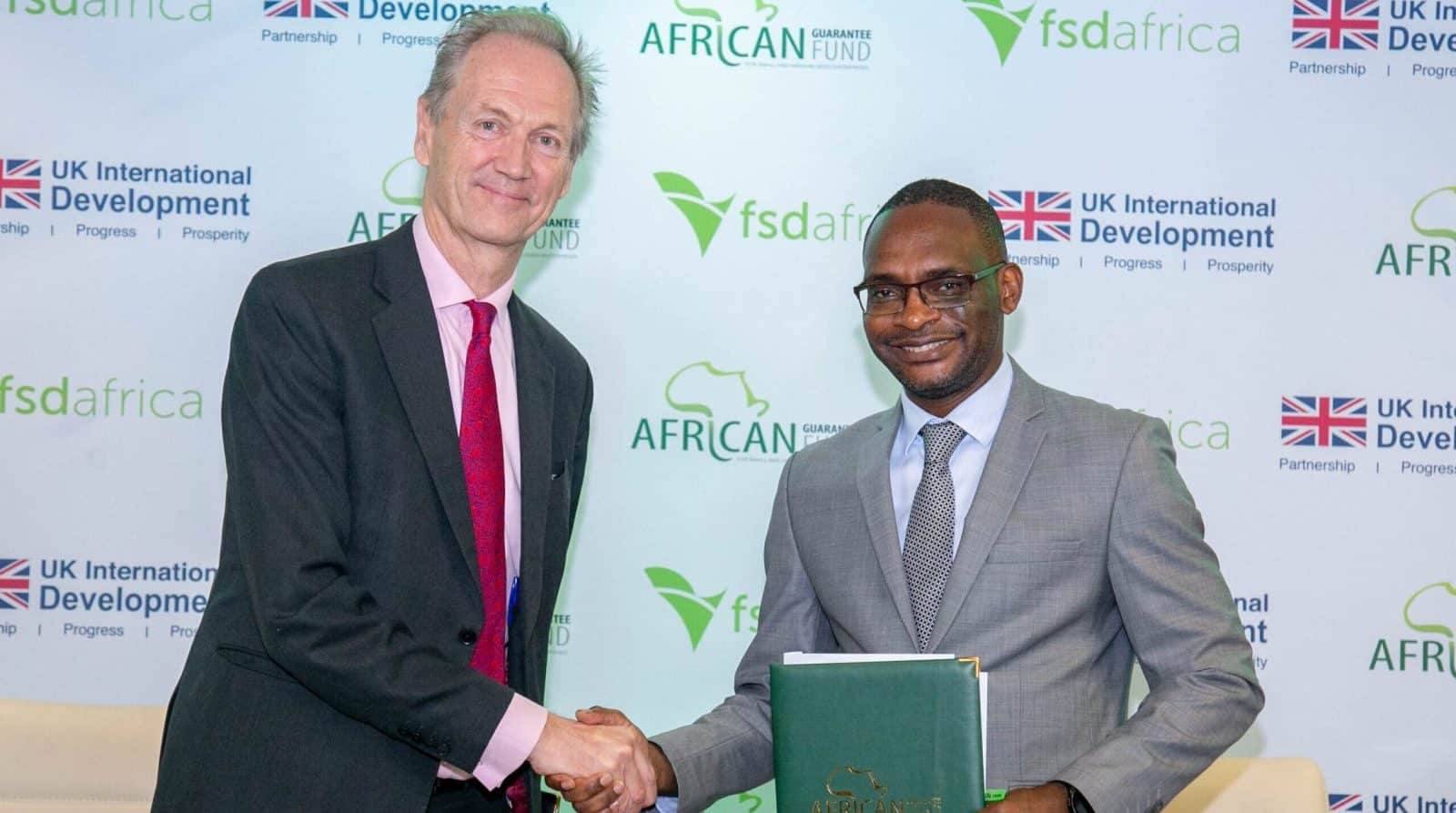
The African Guarantee Fund (AGF), a leader in promoting financing of Small and Medium-sized Enterprises (SMEs) across Africa and FSD Africa, a pioneering development agency committed to reshaping Africa’s long-term financial landscape, have today signed a strategic Cooperation Agreement aimed at propelling the growth of Green SMEs by providing critical financial support, technical assistance, and capacity building.

The Cooperation Agreement outlines a detailed framework collaboration between the organizations in boosting sustainable development in Africa. The main aspects of this partnership involve assisting in the development of financial products for institutions, offering partial credit guarantees for bonds and funds raised on behalf of SMEs, and conducting capacity-building events.

Furthermore, by providing financial support and fostering business growth, Green SMEs are expected to play a pivotal role in reducing CO2 emissions. This active contribution aligns with the overarching goal of preserving the environment and facilitates access to finance for business growth and empowering SMEs to generate and sustain employment opportunities, especially for youth and women.

Speaking during the agreement signing, Mark Napier, Chief Executive Officer of FSD Africa said: “This partnership represents an important milestone in our efforts to foster sustainable economic development in Africa. By leveraging the strengths of FSD Africa and the African Guarantee Fund, we will actively create a robust ecosystem that empowers Green SMEs. This collaborative effort aims at facilitating access to affordable long-term funds, thereby accelerating the transition towards a greener and more resilient economy.”

Jules Ngankam, AGF Group Chief Executive Officer said: “Fostering a green economic transformation in Africa is one of our key priorities. Through this partnership, AGF will provide financial institutions with bank fundraising guarantees to enable them access affordable funds aimed at facilitating loans to SMEs investing in low carbon and climate resilient businesses”.

Additionally, AGF will extend partial credit guarantees to lenders in a bid to enhance credit accessibility for Green SMEs, empowering them to flourish and make meaningful contributions to environmental conservation.

The two organisations will also provide technical assistance on green financing initiatives, which is critical in building the capacity of key stakeholders such as Governments, Financial Institutions, and Green SMEs.

Read original article

Catalyst Fund invests $1.8 million in nine African climate startups

Catalyst Fund, a pre-seed VC and accelerator, backs nine African early-stage climate tech startups with a $1.8 million investment to bolster their impact and growth trajectory.

The nine startups benefiting from the investment include Mazao Hub and Medikea from Tanzania, Earthbond, Zebra Cropbank, and Scrapays from Nigeria, Keep It Cool from Kenya, NoorNation from Egypt, Thola from South Africa, and Tolbi from Senegal.

In September 2023, Catalyst Fund achieved its first close, securing $8.6 million out of its $40 million target for investments in African climate startups. Notable investors include FSD Africa, FSDAi, Cisco Foundation, USAID Prosper Africa, and Andrew Bredenkamp.

The Catalyst Fund, established in 2016 and overseen by BFA Global, supports startups in accessing capital, talent, and market opportunities. This marks the fund’s second round of investments in African startups addressing climate change challenges.

In January 2023, Catalyst Fund allocated $2 million to ten startups focused on developing solutions for Africa’s climate-vulnerable communities.

As a result, this latest investment broadens Catalyst Fund’s portfolio to encompass 19 companies operating in eight diverse markets: Kenya, Egypt, Morocco, Nigeria, Senegal, South Africa, Tanzania, and Uganda. The Catalyst Fund team will offer comprehensive venture building support to these startups, effectively integrating them as extensions of their own teams.

These startups are actively addressing climate-related challenges within various sectors, including agriculture, healthcare, energy access, and waste management.

In 2023, a survey revealed that over 110 million Africans faced direct consequences from weather, climate, and water-related hazards in 2022, resulting in economic damages surpassing $8.5 billion.

In discussing the investment, Maelis Carraro, Managing Partner at Catalyst Fund, highlighted that the models utilized by the startups “empower farmers, healthcare providers, waste workers, and small and medium businesses to effectively adapt to the impacts of climate change, thus fostering economic growth with a positive climate impact.

Additionally, Maxime Bayen, Operating Partner at Catalyst Fund, emphasized that “with these latest investments, [Catalyst Fund] is committed to further diversifying its portfolio across various models, climate adaptation sectors, and geographic regions.

In 2022, Catalyst Fund secured a $3.5 million investment from FSD Africa to enhance its footprint and scalability across Africa. With this funding, its objective is to bolster 40 pre-seed impact ventures focused on developing solutions for marginalized climate-vulnerable communities in Africa, while also offering comprehensive venture-building assistance.

Read original article

Develop innovative solutions to help address challenges hampering insurance services delivery

Insurance Technology companies must develop innovative solutions to help address the challenges hampering insurance services delivery to expand insurance penetration and coverage, Acting Commissioner of Insurance, Mr Michael K. Andoh has stated.

According to him, the difficulty in acquiring Police and Doctor’s report to claim insurance, accessing some remote parts of the country, affected insurance services delivery.

Mr Andoh who stated this in an interview after the opening of a one-day forum on the new Insurance Act ad Innovations in the sector in Accra on Tuesday said the aforementioned challenges if addressed would help prompt claim payment and cost of insurance.

It was on the theme “The New Insurance Act:  Unlocking the Insurance Industry Potential via Innovative Technology.”

It was organised by the National Insurance Commission (NIC) in partnership with Financial Sector Deepening Africa and Myfig.

He said the deployment of technology could reduce the cost of accessing insurance and expanding insurance penetration and coverage.

Mr Andoh said the technology could be a lever to reach a lot of the citizens with insurance.

According to him insurance through digital technology could be sold to people where insurance companies could not go.

He said the objective of the forum was to expose the insurance technology companies to the operations and solutions which would be be needed to boost the industry.

Mr Andoh said the NIC had introduced a sandbox to help insurance technology companies to text their ideas.

Under the sandbox, the NIC had offered two temporal license such as Insurers Innovative License for a period of two years to help insurance technology companies to test their insurance technology products.

The Head of Financial Market and Innovation Unit of the Ministry of Finance, Benjamin Torsah-Klu commended NIC for organising the forum, saying the  Ministry of Finance saw the forum as cutting-edge, as it intends to create a platform for the industry to leverage technology and innovation across the insurance ecosystem for the transformation of the market.

“Government would continue to provide the enabling environment for digitalisation and innovation in order to reduce financial vulnerability. Income inequality and the huge risk protection gap,” he stated.

Mr Torsah-Klu said that the Ministry.of Finance saw the forum as a pragmatic step by the NIC to enhance insurance market development, through innovation and technology.

That, he said, would help accelerate growth and deepen insurance access and penetration, and most importantly, improve livelihood and financial stability of the country.

The Principal in charge of Innovation and Resilience of FSD Africa,  Elias Omondi, said the objective of the FSD Africa was to deepen insurance penetration  in in Africa particularly Ghana. “Our role is how to create the large-scale change within the financial market in Africa and Ghana holds a special dispensation in insurance in Africa,” he stated.

Read original article