Country: Kenya

Capital markets: Absa teams up with professional bodies to boost staff capacity

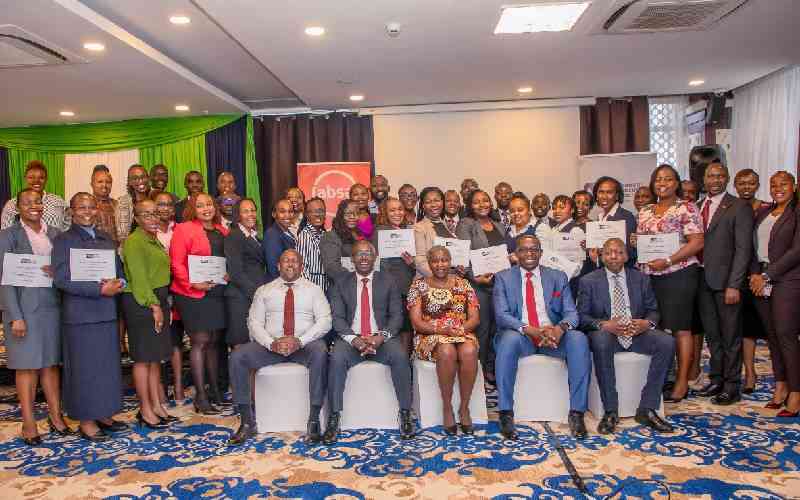
Tier one lender Absa Kenya has teamed up with the Nairobi Securities Exchange (NSE) and the Chartered Institute for Securities and Investment (CISI) to enhance knowledge and expertise of the Capital markets amongst its staff.

The initiative aims to improve the value provided to their customer base by actively engaging in various Capital Markets offerings and achieving the best possible outcomes for their corporate and retail clients’ financial objectives, said Absa.

The capacity building programme dubbed Securities Industry Certification programme was designed by the CISI in conjunction with the Capital Markets Authority (CMA) and Financial Sector Deepening Africa (FSD Africa).

The organisers said it offers a broad introduction to the financial services professional sector, with a specific focus on investments from a global perspective.

It for instance focuses on local and international markets and covers key financial principles and products including assets and markets, equities, bonds, derivatives and investment funds.

The programme enables candidates to better engage with their clientele in determining their objectives, risk profile and constraints towards ensuring advice that is suitable and appropriate to each individual client, a key pillar towards ensuring that a practitioner acts as a fiduciary to their clientele.

The NSE, a CISI Accredited Training Partner, has been working with the Absa team to ensure appropriate delivery of the programme and attaining of the learning objectives.

Outgoing Nairobi bourse chief executive Geoffrey Odundo said the the NSE is committed to building and strengthening the capacity of capital market players through partnering with organizations such as the Chartered Institute for Securities and Investments.

“Capacity of market participants is at the heart of robust market infrastructures and we will continue to pursue strategic initiatives to accelerate this agenda,” he said.

Absa Bank said it will continue to beef up the skills of its workers.

“Absa is committed to continue being a market leader in providing differentiated financial services that are tailored to the unique needs of our client base,” said Absa Bank Kenya Director of People and Culture Mumbi Kahindo.

“Capacity building is key towards achieving this commitment, by ensuring that our people are armed with the right knowledge and skills to deliver the best experiences to our customers and stakeholders.”

CMA director of Policy and Market Development, CMA noted that appropriate capacity building will play a critical role towards positioning Kenya as a premier investment destination and an International Financial Center.

“Adoption of international certification standards will enable more diversified products and services in the market, thus ensuring that we remain competitive and attract international flow of funds,” he said.

His comments were echoed CISI EA Regional Representative Kimacia Gitau.

“We are proud to be associated with Absa and the NSE towards building appropriate Knowledge and expertise among the Absa Premier staff and the sector as a whole,” he said.

“We are fully committed to the advancement and dissemination of knowledge in the field of securities and investments within the region.”

Read original article

Kenya Green Building Society Hands Over Certificate To Governor Sakaja

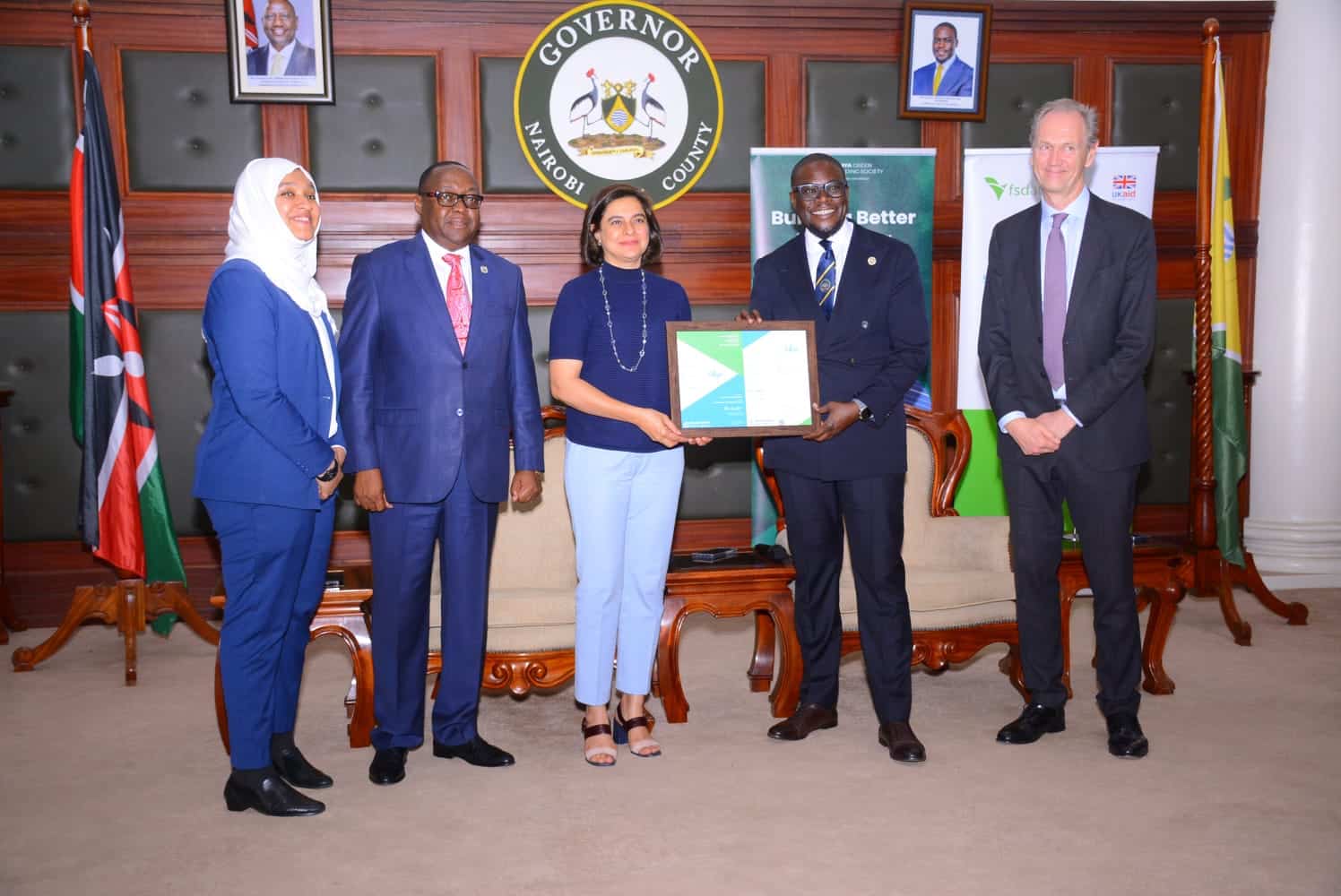
Kenya Green Building Society (KGBS) in collaboration with the Financial Deepening Sector (FSD Africa) and the International Finance Corporation (IFC), handed over the IFC EDGE plaque and certificate to Nairobi Governor Johnson Sakaja in a colourful ceremony in Nairobi today.

The event meant to celebrate the Nairobi City County Governor’s office meeting the IFC EDGE Green Building standard, marking it as the first EDGE certified green government office building in Africa.

The certification follows the conclusion of the United Nations climate conference in Dubai in 2023, which emphasized the pivotal role of cities, local governments, and mayors in combating climate change.

While attending the ceremony, Governor Johnson Sakaja expressed his delight, highlighting two key points.

The Governor emphasized that Africa has the potential to lead the way in designing sustainable spaces to tackle future challenges, given the existing skills, incentives, and capabilities.

Governor Sakaja further expressed the importance of cities and local governments in driving the conversation on climate change and shaping cities that reflect dignity and progress, aligning with the vision of the Africa We Want, with Nairobi as its green capital.

This certification signifies leadership in climate action at the local government level and marks the initial step in Nairobi’s implementation of its Climate Action plan, solidifying its status as the green capital of the world.

Governor Sakaja emphasized that climate change, adaptation, and

environmental management are critical global challenges, but Nairobi stands out for its innovation,

resilience, and leadership.

Nasra Nanda, Chairperson of the Africa Regional Network at World GBC and CEO of KGBS, noted that the certification is not only a victory for Nairobi and other local governments but

also for Kenya and Africa as a whole.

Nasra expressed KGBS’s commitment to leveraging this milestone to advocate for green legislation and to make Nairobi truly the green and resilient capital of Africa, while also unlocking green finance for the city.

Read original article

Access to capital and long-term finance boosted by EABX PLC’s Over the Counter (OTC) Exchange regulatory approval

The receipt of this approval is in line with the ongoing national reforms to enhance debt market infrastructure that will promote trading transparency and increase liquidity.

 Nairobi 1st February 2024.  EABX Public Limited Company (EABX) has received regulatory approval from the Capital Markets Authority to establish and operate an over-the-counter (“OTC”) securities exchange and additionally function as an autonomous self-regulatory organisation (SRO) in the country.

The approval enables EABX to operationalise the Exchange by rolling out its electronic trading platform to its members in Kenya, with a plan to expand operations into the wider East African region in the near future. The licensing of EABX is in line with ongoing reforms in the framework of Public Debt Management, intended to improve national savings, deepen, and improve the domestic debt market infrastructure, spearheaded by the country’s National Treasury.

EABX PLC is primarily sponsored by the Kenya Bankers Association (“KBA”), which is the Exchange’s anchor shareholder, and FSD Africa which has offered its technical support. KBA currently has a membership of forty-seven financial institutions and continues to reinforce a reputable and professional financial services sector in a bid to best support Kenyans, who entrust their ambitions and hard-earned resources with its member institutions. FSD Africa aims to address systemic challenges within Africa’s financial markets, with the aim of sparking large-scale and long-term change.

It is expected that establishment of an OTC Securities Exchange will enhance market infrastructure and broaden the domestic and international investor base as market confidence grows. This will deepen the market and encourage development through innovative products and position Kenya as regional leader in financial market development supporting its Vision 2030 ambitions.

EABX will provide an OTC platform for the trading of fixed income products such as repurchase agreements (REPOs), treasury securities, commercial paper and corporate listings and alternative assets including non-interest financial products. EABX will also play a pivotal role as a Self-Regulatory Organisation in expanding the architecture of the financial services system, modernising supervision and market conduct, improving financial capability, enhancing sovereign debt management and fostering EAC financial integration.

Welcoming the announcement, Mr. Terrence Adembesa, the CEO of EABX said:

“EABX is grateful for the support it has received from the CMA, the EABX interim board of directors chaired by Mr. Kihara Maina, the KBA, FSD Africa and all other stakeholders who have worked tirelessly over the years for the achievement of this significant milestone. As a company, EABX acknowledges that the hard work begins now and looks forward to the opportunity to contribute to the development and expansion of the region’s capital markets.”

Dr. Habil Olaka, CEO Kenya Bankers Association:

“Kenya Bankers Association congratulates the East Africa Bond Exchange Plc (EABX) on the license award to commence OTC Bond trading.  This marks a significant chapter in Kenya’s financial market and presents a new phase of growth and opportunity, expected to transform and deepen the market.  The banking sector looks forward to sustaining its contribution to market development, fostering economic growth and creating lasting value for all stakeholders. This milestone reaffirms the industry’s unwavering commitment to excellence, innovation, and adherence to the highest industry standards.”

 Speaking on the milestone, FSD Africa’s Director, Capital Markets, Dr. Evans Osano said:

“This is the most significant capital market infrastructure development in Kenya and the wider East African region in decades. It promises to uplift the regional fixed income markets to world class status and will be instrumental in mobilizing at scale long-term local currency financing for the East African economies. FSD Africa and co-sponsor the Kenya Bankers’ Association celebrate this critical milestone of EABX’s licencing. We thank CMA Kenya for its foresight and market development instincts.”


About The EABX

EABX Public Limited Company (EABX) is a Kenyan company whose purpose is to establish and operate an over- the-counter securities exchange. As a market organizer, EABX will serve the dual roles of a self-regulatory organization, providing frontline regulation of market conduct, and provision of a trading and trade reporting platform that will enhance transparency, safety, liquidity, and the deepening of the domestic debt market. EABX is sponsored by the Kenya Bankers Association (KBA) with technical support of FSD Africa.

EABX is currently conducting user acceptance tests on its electronic trading platform and is additionally enlisting members into the Exchange from across the market players.

For further information please contact:

Corporate Affairs

EABX PLC

E-mail: info@eabxgroup.com

www.eabxgroup.com

Licensed East African Bond Exchange to take on NSE

Competition in Kenya’s bond market is set to heat up following the Capital Markets Authority’s (CMA) approval of an application for a license for Over-the-Counter (OTC) trading by the East African Bond Exchange (EABX).

The Business Daily has learnt that the market regulator granted EABX the license on Tuesday, setting the stage for competition between the Nairobi Securities Exchange (NSE) and EABX for bond market activity whose annual turnover has averaged Sh734.0 billion between 2020 and 2023.

An OTC market is an infrastructure that allows traders to interact without having to go through a formal securities exchange. The framework works purely through bilateral negotiations between traders without the intervention of the established securities exchange since all trades are captured electronically and directly between the engaging parties.

This comes just a fortnight after the International Monetary (IMF) Staff Report following the January 17, 2024, sixth review of Kenya’s $4.43 billion, Sh717.3 billion, programme indicated that the government had committed the fund to take steps towards an OTC automated exchange to complement the operations of the NSE.

“We will further enhance the market infrastructure through policy support to market participants to operationalise an over-the-counter automated exchange to complement the broker intermediated Nairobi Securities Exchange,” the government committed to the IMF in the just concluded reviews.

“The aim of the exchange will be to promote trading transparency and settlement efficiency and attract more capital in the economy eventually leading to reduction of yields and cost of new public debt.”

This marks the third milestone for EABX with the first having been the no objection for set up acquired in 2020 and the second being the approval for capital raising secured in 2023.

The rollout of an OTC market for bond trading in the country now means fixed income activity in Kenya’s capital markets will be operating much like Nigeria, which has the Nigeria Stock Exchange and the OT bond trading targeted FMDQ Group operating side by side with FMDQ Group having been set up in 2012.

The top leadership of CMA has decried that whereas Kenya was ahead of Nigeria in bond market reforms a decade ago, Nigeria’s set up of an OTC bond trading market has seen the West African economy leapfrog ahead of Kenya in bond trading activity.

“When you look across the globe, the biggest OTC market is foreign currency. You can also find trading in OTC in equities, debt securities, derivatives and many others. Bonds, despite being not very small issuances, are finding their way in most jurisdictions in trading via OTC. Contrary to what you expect in a centralised exchange, the requirements for trading in an OTC market are far less onerous. The annual market turnover for Nigeria’s FMDQ comes to about Sh90 trillion annually and you can see the potential given that we were slightly way ahead of Nigeria in terms of bond market reforms,” CMA’s Director for Policy and Market Development, Luke Ombara, told journalists recently.

The NSE raked in an average of Sh73.2 million per annum in bond levies over the last two years and stands to lose a revenue line should activity gravitate towards EABX. Bond dealers in brokerage entities are also set to take a hit should the OTC market take off and cement direct engagement between traders.

Further, this move comes at a time when the NSE is struggling with depressed activity within the equities market.

The licensing of an OTC market player marks the second major change in under six months in Kenya’s bond market with President William Ruto having launched the new online bond trading platform, DhowCSD, on September 11, 2023.

Read original article

Inside Kenya’s ambitous plan to raise Sh9trn from green bonds

With the framework in place, it is a matter of when, not if, the government will issue a green bond, and experts estimate it may be very soon as no hurdle now stands in the way. Green bonds allow public and private institutions to raise finances to be used specifically for environmental projects that help with climate change mitigation and adaptation.

Through the framework, the government specified the kind of projects that will benefit from the proceeds of a green bond, should it float one, focusing on programmes that will boost Kenya’s environmental sustainability.

“Proceeds of the Kenyan Sovereign Green Bond will be used to finance in whole or in part eligible green assets or projects that are to bc identified from the approved National Budget by Parliament,” states the framework. Some of the projects earmarked to benefit from the financing are sustainable water and wastewater management systems, which are expected to increase supply of water to farmers, households and industry, solving one Of the most widespread challenges associated with climate change today.

Other projects will be in renewable energy, projected to reduce the energy access gap; clean transport, including the much anticipated bus rapid transport (BRT); and green residential and commercial buildings to boost energy efficiency.

Green bond

Experts who worked on the framework say it was built on the International Capital Markets Association’s (ICMA) green taxonomy — a standard on what kind of projects can benefit from funds raised from a green bond. Mr Evans Osano, the Capital Markets Director at Financial Sector Deepening (FSD) Africa, which helped in the development of the framework, explains that

The framework also specifies how the government will select and evaluate projects, how the proceeds will be managed and how the impacts of the investments made from the proceeds will be reported. “Credible, science-based, widely supported guidelines about what assets or projects qualify for green bonds help investors make informed decisions about the green credentials of a bond,” says Vimal Parmar, a senior capital markets specialist at FSD Africa.

This means that unlike traditional bonds, green bonds require a much higher level Of transparency about the use Of the funds raised from them, a factor which has been a double-edged sword for the growth of the green bonds in Africa.

While the idea of green bonds is not new, it has remained an elusive concept for African governments. Since its inception in 2008, only two African countries have so far successfully issued sovereign green bonds.

Nigeria was the first country to float such an instrument in 2019, raising $40 million (Sh6.5 billion), followed by Egypt, which raised $750 million (Sh127 billion) in 2020. Globally, 32 countries have issued green bonds, raising around $355.6 billion (Sh57.2 trillion), of which only 0.2 percent has come to Africa, data from the ICMA shows.

Mr Osano believes that the slow issuance in Africa is because “the requirements are quite onerous; therefore, issuers have to be prepared to meet them”. It is not yet clear how much Kenya will seek to raise from the market in the expected first issuance of a green bond, or whether the bond will be floated locally or on the international market, like a Eurobond. However, the climate finance gap is currently estimated at Shll.16 trillion (S69 billion), which is the amount required to meet Kenya’s Nationally Determined Contributions (N DCS) — the country’s climate change mitigation and adaptation commitments — by 2030.

Osano avers that while green bonds may not raise the entire deficit, they are the most important form of climate finance, as “it has the potential to raise the highest amount for climate finance.” I le estimates that up to 75 per cent Of the gap, about Sh8.7 trillion, could be raised from green bonds by 2030.

Ikechukwu Iheagwarn, East Africa regional director at credit rating agency, contends that green bond investors are indeed more concerned with the environmental impact of the finances they raise, rather that the returns, making green bonds much cheaper than traditional bonds.

“Investors in a green bond won’t look at it like a conventional bond. They look at the expected impact and gives concessional terms, so it will definitely be cheaper than other bonds,” says Mr Iheagwam.

Green bonds market

Today, the global green bonds market is estimated to be worth S 2.2 trillion, more than a tenfold increase from what it was worth about ten years ago, positioning the facility as a leading source of climate finance for African countries. With Kenya now much closer to issuing the financial market product that ever, experts contend that it won’t just be a source Of funds for ‘government
projects, it is expected to bolster economic growth, save lives, livelihoods, and businesses, which are already bearing the brunt of climate change.

“Without the green finance from green bonds, no African country will meet the net-zero emissions goal nor the sustainable development goals. We need the finances to realise those goals,” said Rachel Antwi, head of sustainability at Pan-African lender EcoBank. “Climate change has severe consequences over the short to medium term across multiple sectors, such as agriculture, industry, energy, water, trade and tourism. If we don’t act now, it will impede Kenya’s vision to be a nation that has a clean, secure and sustainable environment by 2030.” Explains ESD Africa’s Parmar.

“Ihe National Treasury estimates that every year, floods alone erode 2 to 2.1 percent of Kenya’s gross domestic product, and droughts cost the country about pollution, general environmental degradation and other challenges which either stem from climate change or increase the country’s vulnerability to climate shocks.

Read original article

Letter: Current package of half measures can’t cure Africa’s debt crisis

Moritz Kraemer’s Markets Insight piece (January 19) rejects the suggestion that the downgrading of African sovereign eurobonds is evidence of an anti-African bias. If anything, Kraemer argues, the credit rating agencies have been rating too generously, evidenced by figures showing the default ratio for B-rated African countries has historically been much higher than the global average.

But the data he presents to support this is patchy. African countries do not have a long history of ratings or even market access and in any case this fails to explain why African countries routinely have to pay more for their debt than Latin American countries with similar or riskier profiles.

Where he is right, however, is that criticising rating agencies will not help to solve the debt crisis affecting more than half the low-income economies in sub-Saharan Africa.

The seriousness of the situation cannot be overstated. These countries are paying an average of 31 per cent of revenues as debt service. This leaves little room for spending on development after recurrent expenditure is accounted for. As a consequence, gains on the poverty front are eroding quickly. The World Bank predicts that across sub-Saharan Africa, per capita gross domestic product, which has not increased since 2015, will drop at an annual average rate of 0.1 per cent over the 10 years to 2025, by when the number of people living in absolute poverty will have reached 472mn, or 37 per cent of the region’s population.

Addressing this situation will need more than the current package of half-measures which are aimed at addressing the liquidity problem for market access countries. Africa’s debt crisis is also a solvency one with developmental ramifications. What is needed is a comprehensive approach: the equivalent of the Heavily Indebted Poor Countries (HIPC) initiative, which the World Bank and IMF launched in 1996 to ensure that no poor country faced an unmanageable debt burden.

But safeguards should be put in place to address the moral hazard of debt forgiveness. There should also be much greater attention on reforming the Common Framework — the G20’s mechanism for dealing with insolvency and protracted liquidity problems — to facilitate orderly and quicker debt restructuring for those market access countries that would need to do so.

Evans Osano
Director, Capital Markets, FSD Africa

Read original article

Dorothy Maseke: Unlocking Africa’s natural capital

For too long, the economic orthodoxy guiding businesses — as well as the central banks and regulators overseeing them — has taken scant interest in the natural capital that underpins so much economic activity. For decades, many have invested their faith in the power of the markets to inexorably protect value and the assets which guarantee it.

However, change is afoot. What’s more, it’s a seismic shift led by Africa.

Natural systems account for 50% of global economic value generation and few can now doubt that natural assets are inextricably linked to economic health. This emerging consensus, that acknowledges nature’s status as an engine of economic growth, could not come sooner.

The world’s stock of natural assets is declining at a disturbing rate. Just one of many depressing examples is the fate of the world’s coral reef habitats, which constitute the biodiversity engine of our oceans and illustrates the scale of the burgeoning crisis: Oceanpanel.org studies indicate that climate change — and the accompanying acidification of the oceans — will destroy 72% of coral reef habitats by the end of this century. That does not account for the toll of overfishing and pollution, which will cause further damage.

Africa’s leadership in integrating nature-related risk frameworks derives from the knowledge that the continent’s share of damage will be disproportionate. Why? The continent claims a quarter of the world’s natural capital, 65% of the world’s arable land, 25% of the world’s global biodiversity and 20% of global tropical rainforest area. Indeed, while the global decline in Biodiversity Intactness Index score amounted to 2.7% between 1970 and 2014, Africa witnessed a decline of 4.2% in its score.

A roadmap for real change

From an environmental standpoint, these statistics suggest a tragedy of unparalleled scale. But economically speaking, the risk is nothing short of existential.

The African Development Bank estimates that natural capital accounts for between 30% and 50% of the total wealth of African countries; and in sub-Saharan Africa, more than 70% of people depend on forests and woodlands for their livelihoods. From agriculture to fishing and tourism, Africa’s economic future is in real, imminent jeopardy.

Establishing nature as a key area of risk management marks a vital first step, from which can follow a roadmap to real, tangible change.

In December, world leaders convened in Dubai for the COP28 climate change conference, which has elevated nature as one of its central themes — an important move since COP15’s adoption of the Kunming-Montreal Global Biodiversity Framework (GBF). The framework contains vital targets for achievement by 2030, including the conservation of at least 30% of land, sea and inland waters, as well as restoration amounting to 30% of degraded ecosystems, and a $500bn annual reduction in subsidies that promote biodiversity loss.

Pre-empting the sceptics, it’s of course true that target-setting and ambitious rhetoric do not themselves address the challenge we face. But establishing nature as a key area of risk management —

requiring sober, active regulatory intervention — marks a vital first step, from which can follow a roadmap to real, tangible change.

Though indispensable, COP is not the only forum for change. The Taskforce on Nature-related Financial Disclosures (TNFD) marks an important shift in how businesses account for their non-financial liabilities, as well as their impact on the surrounding ecology. Its recommendations (already launched in Kenya and South Africa) have convinced much of the private sector that environmental performance is as material as revenues and market share — a shift inconceivable only a decade ago.

In Africa, both the African Natural Capital Alliance (ANCA)-run pilot, as well as the work of TNFD consultation groups in Kenya and South Africa, are revealing significant private sector interest in early adoption of nature-related disclosures. But what about those who supervise the private sector and set the economic ‘mood’?

We’re seeing a real shift in African voices leading the way for change. Many now recognise the need for African private and public sector awareness and capability-building for the successful integration of not only future nature-related risk frameworks and standards, but also broader nature-related capabilities. Without engagement on these topics, there is a danger of creating additional transition risks and barriers to investment in the African continent.

Asserting the centrality of nature

Arising from the 2017 ‘One Planet’ summit in Paris, the Network of Central Banks and Supervisors for Greening the Financial System (NGFS) has undertaken impressive work orienting the financial system to manage risks and mobilise capital for green investments. With 129 members hailing from every major region of the world, there is a real appetite among regulators for guidance on natural assets and capital. Crucially, African regulators have led the development and implementation of these recommendations, and from Morocco to Nigeria, Kenya to Ghana and South Africa, financial authorities are asserting the centrality of nature in national economies and economic strategies.

Both the TNFD and the NGFS have established frameworks and regulatory best practices to encourage natural capital’s incorporation into economic thinking and strategy. However, many continue to doubt the real, material economic benefits nature affords.

An economic case for natural conservation and restoration could invoke almost limitless examples, but mangrove restoration represents a particularly striking case in point. As well as being almost peerless havens for biodiversity, mangroves turbo-charge local economies and, indirectly, the broader global economy. For example, a staggering 80% of world fishing catches depend in some way on mangrove forests.

Beyond fishing and carbon sequestration, mangroves also matter to world business because they insulate coastal economies from the ravages of erosion, flooding, storms and tsunamis. They are, in essence, nature’s first line of defence.

Again, the coastal defences provided by mangroves benefit more than those inhabiting coastal regions — indeed, they are of vital importance to any business with direct or indirect connections to suppliers, customers, or services in major world economies such as India, Brazil, the Philippines, Ivory Coast, Mexico, China, Vietnam and Bangladesh. The ability of these economies to withstand the growing threat of rising sea levels will prove vital for the world’s supply chains and those companies hoping to reach consumers in much of the Global South — where a growing proportion of the world’s future customers will live and work.

Channelling capital into projects, such as those undertaken by the Global Mangrove Alliance, and ensuring regulation deters coastal depletion and deforestation, ranks as one of many nature-related challenges financial authorities will face over the coming decade. Failure to do so will unleash human and economic damage to global growth on a scale which will easily outstrip the disruption wreaked by the COVID-19 pandemic.

Few businesses are insulated from these risks

It’s worth restating the global implications of this threat — few, if any, businesses on Earth can reassure themselves that they are insulated from these risks. A survey of these threats makes for depressing reading. However, there’s another story to tell — one in which natural capital underwrites sustainable development and becomes a cornerstone of rapid economic growth.

With 75% of African countries having sea access, a sustainable blue economy promises significant long-term wealth if well-managed. The Green Growth Knowledge Platform, for example, found that every US dollar invested in marine protected areas in Senegal and Tanzania generated more than $5000 in economic value. A carefully managed process of extraction and processing could well endow the continent, which hosts 30% of the world’s mineral reserves, with economic firepower previously unthinkable.

Moreover, if financial regulators are able to construct a credible global market for carbon and biodiversity credits, Africa’s vast natural wealth can be, simultaneously preserved and monetised.

It’s a truth most MBAs cover in their first lesson, but one that we seem to have collectively forgotten: strong risk management is impossible without real transparency and honesty.

It’s time, therefore, to think about nature and its preservation not as a fluffy add-on or stamp of corporate virtue, but as a core business consideration — as material as accountancy rules or corporate governance regulations. The shift in attitude must be stark. Just as regulation protects business, investors and the public from practices such as fraud, which ultimately destroy value, so must financial authorities work to protect that which underpins all human activity: nature.

On December 5, ANCA — whose mission is to catalyse nature- positive African economies — hosted a session at COP28’s Blue Zone to discuss the results of a pioneering, first-of-its-kind stress test of nature risks across five African financial systems. We know the threat to Africa’s natural capital is looming, but it’s key that we establish just how exposed economies are, and in what ways. Only then can central banks and regulators intervene to ensure the strength of African financial systems, and the resilience of the environment and ecology which underpins them. Action is needed — and for this to be effective, clarity on where and how is key.

Africa is sitting on a green gold mine — but its institutions must work to protect the inheritance of Africans, both living and as yet unborn.

Dorothy Maseke is Africa lead, nature finance and Taskforce for Nature–related Financial Disclosures at FSD Africa, and head of the African Natural Capital Alliance.
FSDAi Nyala Facility Extends $1mn to WIC Capital to Boost Gender Lens Investing

FSDAi Nyala Facility BV has extended a USD 1 million loan to WIC Capital, a local capital provider investing in Senegal and Côte D’Ivoire that focuses on financing women-owned and managed Small and Growing Businesses (SGBs).

WIC Capital is led by Ms. Evelyne Dioh Simpa, a Fund Manager with a wealth of finance experience and supported by a robust team and board.

WIC Capital has a strong alignment with FSDAi Nyala Facility due to its unwavering commitment to promoting access to finance for female owned SGBs needed to expand their businesses.

For example, in Senegal, a mere 3.5% of women entrepreneurs access credit from financial institutions.

WIC Capital focuses exclusively on investing in businesses owned and/ or led by women, demonstrating that the financing gap for female-owned enterprises in West Africa can be addressed.

Furthermore, WIC Capital stands out for its innovative product structures tailored to local SGBs.

Notably, its origins in an exclusive women’s angel network, adds to its uniqueness within the FSDAi Nyala Facility portfolio, making it an invaluable learning opportunity for all investors in the small and growing businesses investing ecosystem.

Women entrepreneurs in Africa not only encounter challenges when it comes to access to finance but also grapple with the scarcity of platforms offering the essential knowledge and assistance required for the expansion of their businesses.

WIC Capital works with early-stage, women-owned/ led enterprises to provide first-time external capital as well as business training and mentorship.

Also, WIC Capital leverages a large network of successful women entrepreneurs and civic leaders to co-fund and support these emerging businesses.

The business training and mentorship is provided by the WIC Académie through a technical assistance program.

Alongside the women’s angel network, other funders of WIC Capital include foundations, multilateral donor agencies, and development financial institutions.

“Through its investment in WIC, FSDAi is backing an African women-led capital allocator with deep local angel networks, a creative funding structure and financing solution for small and growing businesses in West Africa. With our investment, WIC can position itself to attract bigger pools of capital to expand its strategy in Senegal and Cote d’Ivoire,” noted Anne-Marie Chidzero, Chief Investment Officer at FSD Africa Investments.

“I am proud that the UK is investing US$1 million in WIC Capital through Financial Sector Deepening Africa Investments. I have seen first-hand WIC Capital’s inspiring work and know that they are a deeply impact-focused organisation. They support young female entrepreneurs in a market where access to funding is a huge barrier for their growth. At the heart of building sustainable and inclusive businesses lies the need to advance gender equality through women’s economic empowerment. I look forward to continuing our collaboration to create jobs and empower Senegal’s talented women,” noted Juliette John, UK Ambassador to Senegal. 

“FSDAi is playing a critical role in the development of an emerging asset class of small business growth funds Africa, particularly women-led funds. The funding of WIC Capital represents an important confirmation of WIC’s innovative approach to financing early-stage women businesses in West Africa.  By melding their business development services, women investment club mentoring with investment capital, WIC provides a comprehensive approach to the challenges that to date have constrained Africa’s women-led businesses to growth and thrive.  We believe this commitment will be the foundation upon which other DFIs and local institutional capital holders can also provide funding to WIC Capital and other innovative local capital managers seeking to invest in Africa’s women businesses,” noted Drew von Glahn, Executive Director of the Collaborative for Frontier Finance.

“WIC Capital’s mission aligns with FSDAi’s desire to address the disfunctions of African capital markets, which include the structural barriers that small businesses face in accessing financing, specifically when they are women led. This partnership will be catalytic in the development of a local capital provider that has the potential to profoundly change the local ecosystem, by providing risk capital and business support to women led small and growing businesses (SGBs), with the ultimate goal of increasing women’s agency and economic benefit. With this investment, we are closing our first fund, and we believe this partnership will help accelerate the mobilization of our second fund to serve SMEs generating a strong impact in Senegal and Côte d’Ivoire,” concluded Evelyne Dioh, Managing Director of WIC Capital.

Read original article

TDB Group and FSD Africa Collaborate on Project Preparation Facility for Climate Action Projects in Africa

The Eastern and Southern African Trade and Development Bank Group (TDB Group) and Financial Sector Deepening Africa (FSD Africa), are pleased to announce a new partnership on the sidelines of COP28 to accelerate the implementation of climate action projects across the continent.

In 2022, TDB launched Class C Green + shares, an innovative equity instrument that provides a pathway for institutional investors to contribute to climate action and SDGs with risk capital, leveraging each dollar invested four times into qualifying projects and transactions.

However, the challenge of lack of bankable green projects persists. To address the latter, TDB Group has set-up a project preparation facility for climate action projects which FSD Africa will strengthen through technical assistance support under this agreement. More specifically, FSD Africa will support the Group through expert services to expand its lending pipeline in line with its Climate Finance Strategy and Green Taxonomy, enable aligned projects to reach financial closure, as well as to continue mobilizing new climate-themed capital to deploy.

Expanding the pipeline of green projects is indeed a priority for TDB Group to meet its commitments in supporting its member states to address climate mitigation and adaptation needs, as well as to create additional opportunities for further investments in Class C Green + shares and deploy available climate-themed funding.

Mary Kamari, TDB Group Corporate Affairs and Investor Relations Executive said, “TDB Group has been positioning itself to accelerate the financing of climate action through its Trade and Development Fund (TDF), where a project preparation facility was set-up. We are pleased to enter into this agreement with a likeminded partner like FSD Africa which will extend valuable capacity support towards our vision to advance climate action in the region.”

Mark Napier, the CEO of FSD Africa said, “Multilateral Development Banks are an important part of the financing ecosystem in Africa. Our partnership with TDB Group will increase project pipeline opportunities, and avail innovative financing instruments and structures to attract institutional capital for Africa’s sustainable development priorities. We are pleased that two African institutions are collaborating on solutions for Africa’s climate financing gap.”

Read original article